


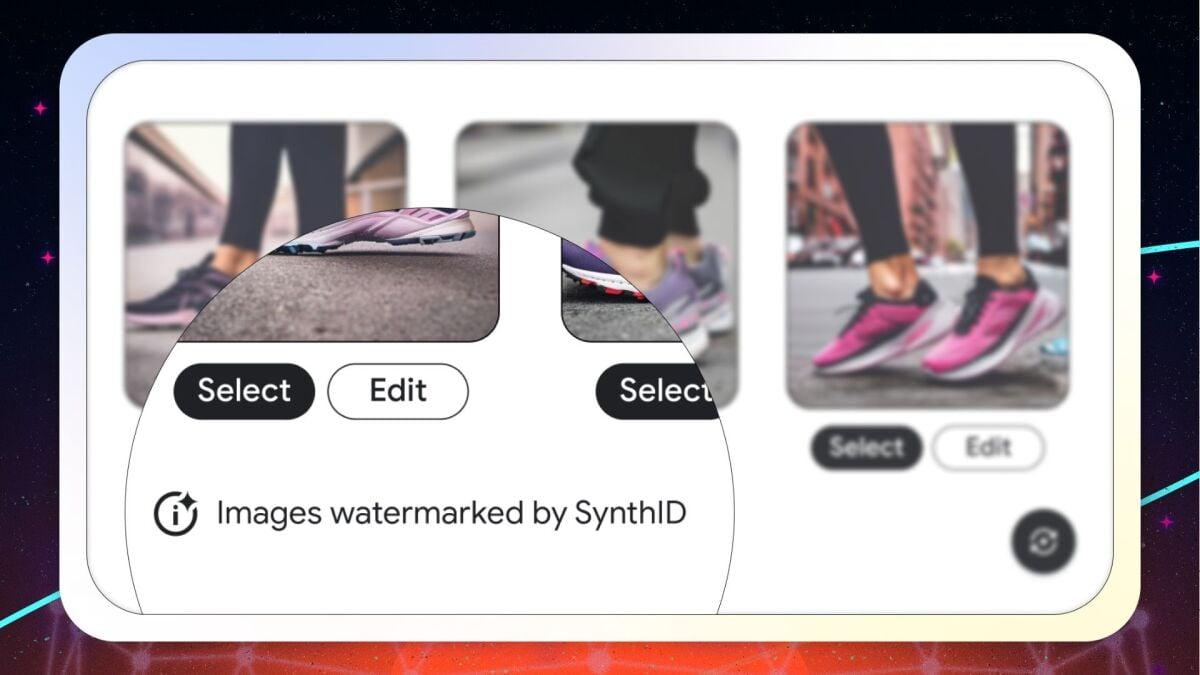
We live in a world where people need the ability to quickly and accurately identify AI-generated content. And at Google I/O 2026, the company announced a massive expansion of its SynthID digital watermark initiative.
At Google I/O 2026, the company announced that it is adding the Google DeepMind SynthID tool as well as content credential verification from the Coalition for Content Provenance and Authenticity (or C2PA) to Search and the Chrome browser. In the Gemini app, C2PA Content Credentials verification will be available starting today.
By expanding this tool to Chrome and Google Search, users will be able to more easily check if a particular image, audio file, or video is generated by AI. As deepfakes and AI videos become a growing problem, digital watermarks are one of the only reliable ways to identify AI-generated content.
Since launching SynthID, Google says that it has watermarked more than 100 billion images and videos, plus 60,000 years of audio content.
In addition, Google announced that OpenAI, Kakao, and ElevenLabs will incorporate SynthID into their products, as well. So, if you see an image that was made with OpenAI's ChatGPT, for instance, it should be watermarked with SynthID going forward.
Mashable Light Speed

SynthID in action. Credit: Screenshot: Google
Both SynthID and C2PA exist to help users detect when something is AI-generated; C2PA verification is provided as metadata, and SynthID is an invisible watermark that can hold up even when metadata is lost.
"These two systems reinforce each other. C2PA helps content carry detailed context; SynthID helps preserve a signal when metadata does not survive," OpenAI stated in a press release. "Watermarking can be more durable through transformations like screenshots, while metadata can provide more information than a watermark alone. Together, they make provenance more resilient than either layer would be on its own."
With these tools, it should be as easy as right-clicking on something and asking if it was generated by AI, at least according to Google.
"We want to make sure more people have easy, seamless access to these tools. So, we are expanding both content credentials and syntary verification to Google Search and Chrome," Alphabet CEO Sundar Pichai said in a briefing ahead of I/O. "That means you can simply circle to search an image, or right click in Chrome and ask, ‘Was this generated with AI?’ and you'll get a clear response, along with other helpful context.”
Looking for more Google I/O announcements? Follow the Mashable Google I/O live blog to see all of the latest news on Gemini, Chrome, and Android.
Disclosure: Ziff Davis, Mashable’s parent company, in April 2025 filed a lawsuit against OpenAI, alleging it infringed Ziff Davis copyrights in training and operating its AI systems.

 English
 Arabic
 French
 Spanish
 Deutsch
 Turkish
 Dutch
Dutch
 Italiano
 Russian
 Romaian
 Portuguese (Brazil)
 Greek
Greek