




Rob Kim/Getty Images
It's hard to imagine cooking without salt — try to find any recipe without it. Salt helps enhance the flavor of ingredients you're cooking with, but sometimes, there are health situations where a reduction of sodium intake is encouraged. So how can you make a good meal when it's called for in every dish? Chef José Andrés has a solution: Turn to salt's ever-present sidekick, black pepper.
Although this dynamic duo is almost always paired together, chef Andrés explained in an interview with Food & Wine that the key to salt-free cooking is experimenting with spices to ensure that it doesn't taste like the dish is lacking in anything. He personally likes to stick with a classic: "I like black pepper, but you make sure it's fresh and make sure it's very fine. And this is a good substitute for salt." FYI: Black pepper doesn't exactly expire, but it can lose flavor after a year or more, so that's why he recommends fresh.
It's an interesting substitute, as salt and pepper don't share many similarities. Salt is a mineral comprised of sodium and chloride, and it's mined from the earth around the world or extracted from sea water. There are many different styles of salt, but most of the time, it doesn't have much of a flavor besides saltiness. Black pepper is actually a dried berry that comes from the Piper nigrum vine, which is native to South India. It essentially works as a salt replacement by covering the lack of saltiness with fragrance and spice.
Using black pepper in place of salt
Khouwes/Getty Images
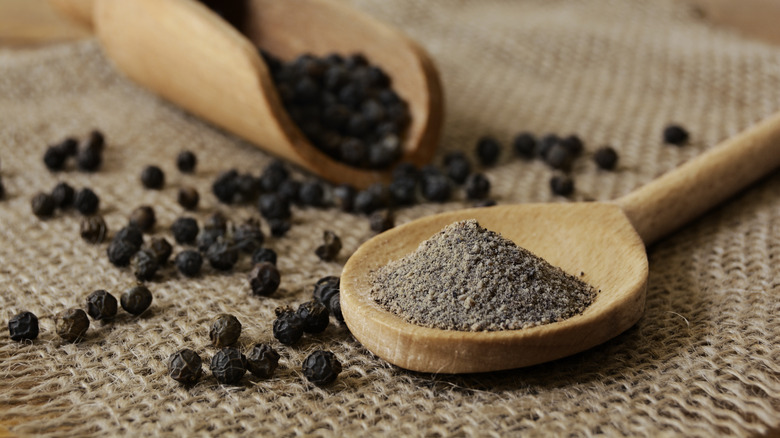
As chef José Andrés touched on, the key to unlocking pepper's full potential lies in its texture. Finely ground pepper disperses evenly across food. A finer grind more closely mimics the way salt incorporates with food, and will integrate more easily into a dish. Coarsely cracked pepper may be more visually appealing, but it delivers uneven bursts of spice with some underseasoned pockets.
When using black pepper as a salt substitute, you'll likely use more than you normally would — but with caution. Use it as called for in the recipe, and then season to taste afterwards. Over time, you'll develop a sense for how much is needed to account for the lack of salt. Because pepper provides spice and fragrance rather than the salinity your palate is used to, your brain won't register the same immediate satisfaction — it can take weeks to upwards of two months to become adjusted to salt-free cooking.
All black pepper looks pretty similar, but the variety you choose affects the flavor profile. Tellicherry pepper (grown in India) is considered one of the best types of black pepper, and it's bright, citrusy, and slightly sweet. Sarawak pepper from Malaysia is somewhat milder and earthy, while Brazilian pepper is sharper and more pungent. Don't forget about white pepper, which is slightly different than black. Although it comes from the same plant (but the outer black hull of the berry is removed), it offers a delicate, sweeter flavor with a more subtle heat.

 Arabic
 French
 Spanish
 Portuguese
 Deutsch
 Turkish
 Dutch
Dutch
 Italiano
 Russian
 Romaian
 Portuguese (Brazil)
 Greek
Greek