


AMD Ryzen 5 7500X3D review - peak frame rates for under $300
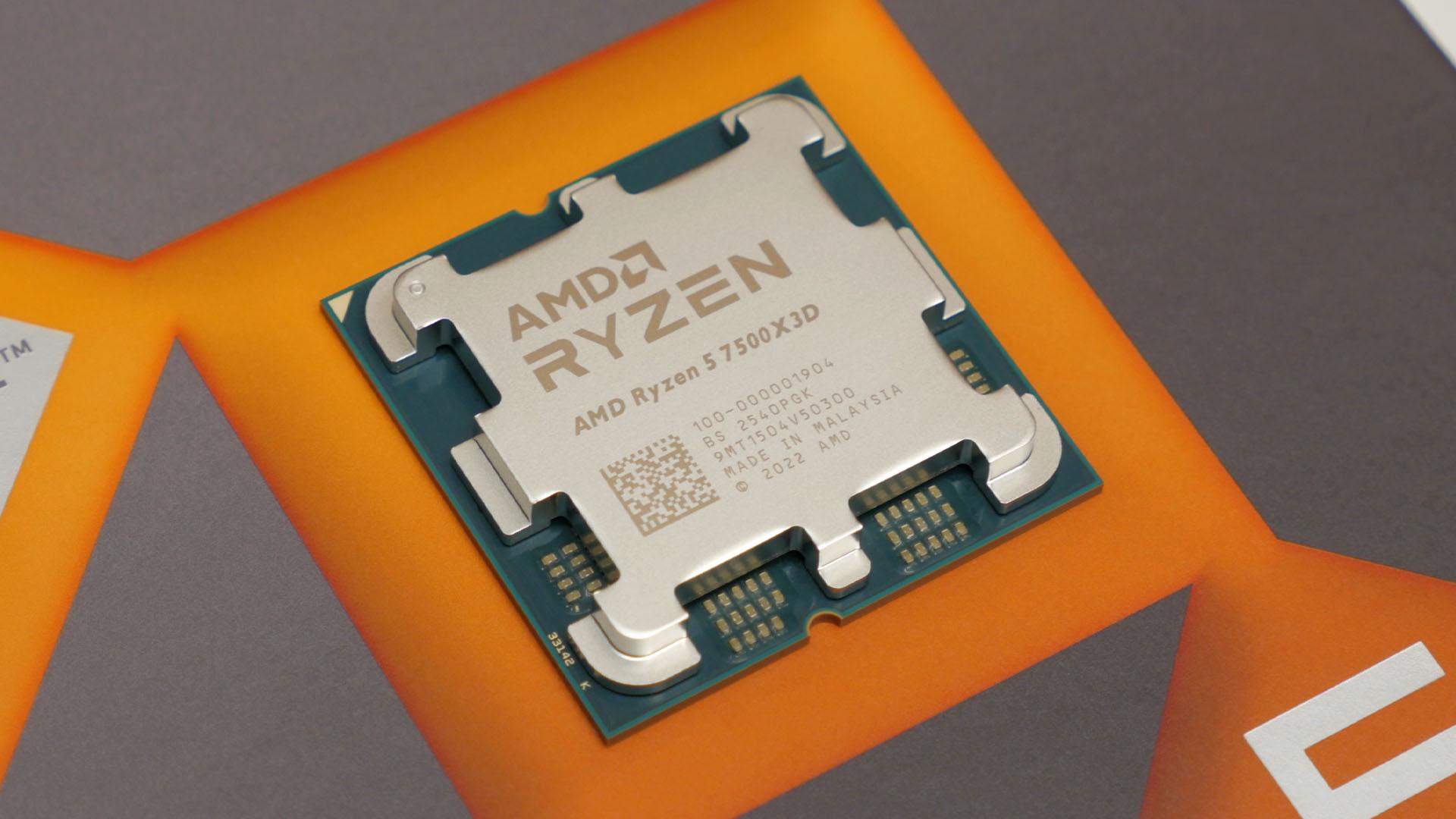
AMD Ryzen 5 7500X3D review - peak frame rates for under $300
Verdict

A hard sell when it first launched, a few months later the AMD Ryzen 5 7500X3D is even less convincing an option for most buyers. It excels at gaming in general, and is particularly good for CS2 and other very high frame rate gaming situations, so it's certainly still a solid option. However, it's so weak elsewhere that it falls well short of an outright recommendation for most right now.
Pros
- Consistently good gaming performance
- Particularly good for high frame rate esports gaming
- Runs cool and doesn't draw much power
- Gets you started on the AMD AM5 platform
Cons
- Weak performance at everything other than gaming
- Often beaten at gaming by the 270K Plus
- Poor value compared to the competition
The AMD Ryzen 5 7500X3D should have been one of the most exciting CPU launches in some time, as this relatively budget chip brings AMD's game-performance-enhancing 3D V-Cache tech to a new low price point on its AM5 platform. However, while its gaming performance is very solid, it's not a particularly cheap option and is weak for non-gaming tasks.
This balance of power means the 7500X3D still earns a place on our best gaming CPU guide, but not as a value champion, as such, or an all-around performer. Instead, if you're simply after peak frame rates, particularly for competitive gaming where frame rates push well beyond 300fps, this chip delivers the X3D goods for far less than any other modern AMD CPU. While the 7500X3D came out at the end of 2025, our delayed review means we've had the chance to compare it to Intel's two new price-competing options, the 270K Plus and 250K Plus. Read on to see how they all stack up.
Specs
| AMD Ryzen 5 7500X3D specs | |
| Cores | 6 |
| Threads | 12 |
| Peak boost clock | 4.5GHz |
| Base clock | 4GHz |
| L2 cache | 6MB |
| L3 cache | 94MB (32MB on-chip, 64MB 3D V-cache) |
| TDP | 65W |
| Architecture | AMD Zen 4 |
| Socket | AMD Socket AM5 |
| Price / MSRP | $269 / £250 |
The AMD Ryzen 5 7500X3D specs are broadly very modest, with this $299 chip packing in just six CPU cores, hitting a peak clock speed of just 4.5GHz - 1GHz slower than AMD's fastest X3D chips - and a rated TDP of just 65W. The core count is bolstered by the fact that this chip supports simultaneous multi-threading (SMT), which means each core can handle two application threads at once, and so appears to your OS like it has 12 cores. However, its true multi-core performance isn't anywhere close to a 12-core chip.

Of course, as with any of AMD's X3D CPUs, the secret sauce here is the inclusion of an extra die alongside the main CPU that provides a huge extra chunk of 64MB 3D V-Cache. This gives the CPU triple the cache it would normally have, which reduces the need for the chip to access main RAM to get its data, greatly enhancing performance in certain tasks. Which tasks? Well, gaming is the single biggest winner, which is why they're so coveted for gaming PCs.
Otherwise, this CPU is blessedly honest in its naming, with its 7000 series numbering openly acknowledging that this a CPU that uses AMD's older Zen 4 architecture, rather than the Zen 5 used in its latest 9000 series chips - there's no rebranding of older stock here.
This means it's a touch slower in terms of performance per clock, and that, like other 7000 series chips, its clock speed can't stretch to the heights of 9000 series models. Part of the reason for this is that the extra cache die sits on top of the CPU cores in 7000X3D chips, which limits how quickly heat can be wicked away from those cores. With the 9000 series X3D models, the cache die is on the bottom, bringing the CPU cores to the top, right underneath the metal heat spreader on which you place your CPU cooler.
All of which is to say that while the X3D cache in this chip does bring a big performance boost for some situations, everything else about this CPU does feel like the four-year-old design on which it's based.

While its CPU core design might be old, this chip still uses AMD's latest AM5 motherboard socket, though, and that highlights one of the big advantages of this chip over Intel's rival Core Ultra 200 options, and AMD's older AM4 CPUs, like the 5800X3D. Opt for this CPU now, coupled with one of the best AM5 motherboard options, and you could upgrade to the likes of the 9800X3D or 9950X3D at a later date. Plus, AMD has committed to supporting AM5 for at least one more generation of CPUs, meaning a motherboard bought now could see you last for many years and upgrades to come.
How we test
I've put the AMD Ryzen 5 7500X3D through our usual benchmark suite, mounting it in an Asus X870E ROG Crosshair Hero motherboard alongside 32GB of (2 x 16GB) G.Skill TridentZ 5 Neo RGB 6,000MHz, CL28 RAM, a 2TB WD Black SN850X SSD, and an Nvidia GeForce RTX 4080 Founders Edition graphics card. The CPU is cooled by a Corsair H100x 240mm AIO cooler and the system powered by a Corsair RM1000x Shift PSU.

All our tests were conducted using a fully up to date version of Windows 11, with the motherboard flashed to the latest BIOS version. The comparison Intel CPU tests in the graphs below were conducted using an Asus Z790 Dark Hero motherboard for LGA1700 CPUs, and an Asus TUF Z890-Plus WiFi was used to test the LGA1851 chips.
Game benchmarks
As hinted at throughout this review so far, the 7500X3D really is a capable option when it comes to most gaming, and that's amply demonstrated with our first benchmark, Cyberpunk 2077. Even with our first test scenario using the highly GPU-demanding ultra ray tracing preset, there are still clear differences between CPUs, and the 7500X3D comfortably pulls ahead of the likes of the Ryzen 5 9600X, Core Ultra 7 265K, and Core i5 14600K. However, those two new Intel options, the 270K Plus and the 250K Plus actually outperform it, with AMD's own more powerful X3D options also pulling well ahead.

It's a similar, and in fact worse, story for the 7500X3D when we drop to our less GPU-demanding high detail/no ray tracing test. Frame rates jump up considerably, but relative to other options, the 7500X3D isn't so impressive. It only manages to beat the old 14600K, with even the Ryzen 5 7600X and Core Ultra 7 265K sneaking ahead. The margins are close in this test, though.

Where the margin is less slim, though, is in our Total War: Warhammer 3 Mirrors of Madness benchmark. This demanding test really benefits from a CPU with lots of fast cores, and the 7500X3D simply can't compete. It comes in last in our chart, with a frame rate that matches that of the Core Ultra 5 250K Plus and Ryzen 5 7600X but is 45% slower than the 9800X3D. Incidentally, we've not included comparisons to the 9850X3D, as it's basically just the same as the 9800X3D but 5% faster and even more expensive, so isn't much of a useful reference for a CPU nearly $200 cheaper.

Completely flipping its fortunes, in the less-demanding Total War: Warhammer 3 Battle benchmark, the 7500X3D somehow sneaks into second place, though the margins in this test are so fine, it's a fairly pyrrhic victory.

It's the same story with our F1 24 test, which sees the entire field of CPUs on test sit within 3% of each other. The fact the 7500X3D comes in joint last is a bit embarrassing for it, but shouldn't really affect your buying decision.

So far, so quite unimpressive for this chip, with it showing occasional hints of its X3D capability, but not being the most consistent option. However, where this CPU really shows what it can do is in our CS2 benchmark.

Running the game at 1080p with high detail settings, it, along with all the other AM5 X3D chips, pulls miles ahead of Intel's competing options. While the 7500X3D will get you 445fps in this scenario - ideal for pairing with an ultra-fast 360Hz+ gaming monitor - the fastest Intel Core Ultra option, the 270K Plus, struggles to just 321fps. That's still a high frame rate, of course, but if you have a really fast monitor, it won't be the right choice of CPU for you.
Application benchmarks
Unsurprisingly, the 7500X3D is no powerhouse when it comes to non-gaming situations. It's still a perfectly capable six-core chip that will be entirely adequate for all casual desktop use. However, if you're after a CPU that can do some serious multi-threaded work - or even just deliver some particularly fast single-core responses - it won't be your best bet at this price.
In Cinebench R24's multi-core test, the 7500X3D came dead last in our list of test CPUs. It's worth reiterating that it would still be faster than plenty of even more budget and older CPUs - it's faster than an Intel Core i5 10600K or Ryzen 5 3600 - but compared to other modern options, it's well off the pace. Most notably, the Core Ultra 7 270K Plus is the same price as the 7500X3D (at least on paper) and is more than three times faster in this test.

It's not a much better story in the Cinebench R24 single core test, with the 7500X3D again coming in last, though the margins are a lot tighter than the multi-core test.

Power draw
Thanks to its modest core count and clock speed, one area where the 7500X3D excels is in power consumption. That Cinebench R24 multi-core score might have been low, but while completing the test, the 7500X3D consumed far less power than any of the other chips we tested.

Meanwhile, in our Cyberpunk 2077 gaming test, our system drew 410W, putting it in third spot overall for our test CPUs. If you want a processor that can deliver very high frame rates without drawing a boatload of extra power, this is a great choice.

Temperature
Another area of excellence for this CPU is its heat output. Hitting just 74°C while under full load, it's an easy chip to keep cool, making it well-suited to being fitted with one of the best budget CPU coolers, such as the Thermalright Peerless Assassin.

It's a similar story in games, though as with the power consumption tests above, this chip doesn't quite top the charts. The extra power efficiency of AMD's latest CPU architecture means the 9800X3D is even more efficient, as are a couple of Intel's Core Ultra options. Still, at just 68°C while playing Cyberpunk 2077, it's again an easy chip for most CPU coolers to handle.

Price
The AMD Ryzen 5 7500X3D price is where the wheels slightly fall off for this CPU. At $299, even at launch it was already expensive for its balance of good gaming frame rates but weak performance in other areas. However, with Intel's new 270K Plus and 250K Plus now arriving at extremely aggressive prices, the 7500X3D only makes sense for one type of user: those who want maximum frame rates in competitive gaming titles for minimum budget.
Alternatives
Intel Core Ultra 7 270K
Everything about the 270K Plus's specs suggests it isn't remotely a competitor to the 7500X3D, what with it having 24 cores to the 7500X3D's six. However, Intel has been so aggressive with the pricing of this CPU that it's the same price as the 7500X3D. It annihilates it at everything other than that peak frame rate in our CS2 test. If hitting 450fps instead of 300fps is a priority, grab the 7500X3D. Otherwise, get the 270K Plus. Just be aware that there's no upgrade path available with this Intel choice. You'll have to swap your motherboard to get more performance in the future.
Read our full Intel Core Ultra 7 270K review.
Intel Core Ultra 5 250K Plus
If you simply want the best bang-for-buck CPU right now, the 250K Plus is it. While it can't so consistently beat the 7500X3D in gaming as the 270K Plus, it trades blows, and, like the 270K Plus, it trounces the 7500X3D at everything else. Its 18 cores just give it so much headroom for other tasks. It's also $100 cheaper. Like the 270K Plus, though, it has limited upgrade potential.
Read our full Intel Core Ultra 5 250K Plus review

Verdict
When it first launched at the end of 2025, the 7500X3D already seemed like a surprisingly expensive option for a six-core CPU based on the company's three-year-old architecture. The 3D V-Cache that gives it its X3D name, and which helps it to provide some impressive gaming performance, wasn't enough to overcome its relatively modest clock speed and low core count, even compared to the competition at the time. It was at best an 8/10 option then.
Fast forward to our regrettably delayed review of this chip, and it's an even sorrier story. The Intel Core Ultra 270K Plus and 250K Plus are simply too strong at this price for the 7500X3D to make for a sensible purchase. The 7500X3D needs a $50+ price cut, stat.
There are two caveats to this conclusion, though. The first is that the 7500X3D does still hold a strong lead in ultra-high frame rate gaming tests. So, if you have a 360Hz+ gaming monitor and want to maximize its potential, the 7500X3D does this better than the 270K Plus and 250K Plus.
The second is that AMD's AM5 platform offers a fantastic upgrade path. Opt for this or any other AMD AM5 CPU today, and you'll be able to upgrade to the undisputed fastest gaming CPU right now, the 9850X3D, or the fastest CPU overall, the 9950X3D, plus the next generation of AMD CPUs when they arrive.

 English
 Arabic
 French
 Spanish
 Portuguese
 Deutsch
 Turkish
 Dutch
Dutch
 Italiano
 Russian
 Romaian
 Portuguese (Brazil)