


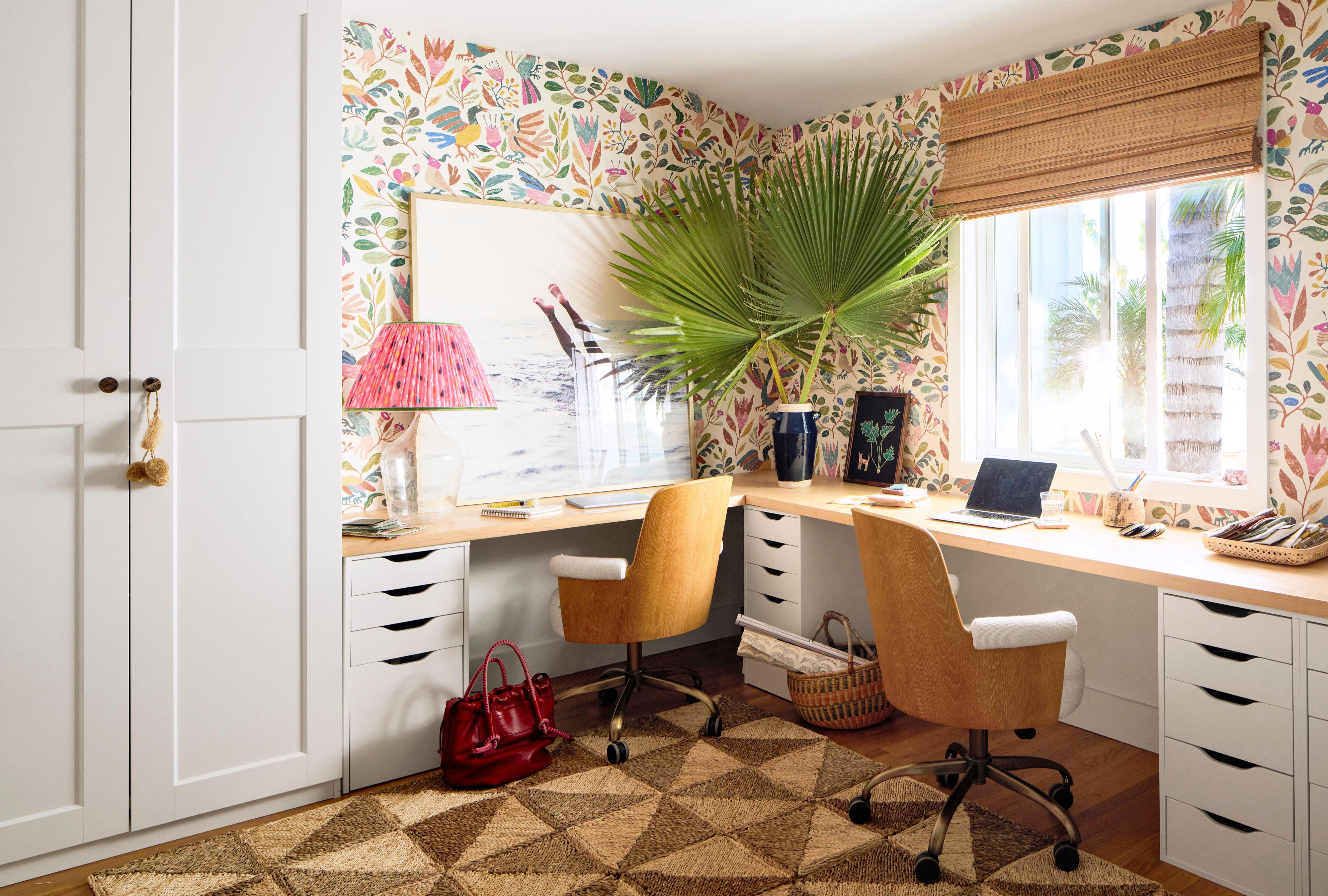
How much can your home work environment affect your work output? Franky Rousell, founder and CEO of Jolie Studio, says the impact can be profound. At the top of the list of must-haves for a home office, the ability to carve out a space that supports both work output and mental clarity is key.
“[Your work environment] should feel distinct from the more relaxed, family-oriented areas of the home, acting instead as an extension of your professional life—a sanctuary where you can step into your most empowered and capable self,” says Rousell. “Design choices play a huge role in supporting that.”
Rousell advises viewing your space through a sensory lens that considers sound, color, texture, and fragrance. Using this perspective, avoid the following six things productive home offices never have, so you can create a hardworking home office that helps you reach your professional goals, whatever they may be.
Franky Rousell is the founder and CEO of Jolie Studio, a sensory-led interior design firm.
1. Impersonal Surroundings
Hard floors, bare walls, and furnishings that do nothing to soften the space can create a home office that feels anything but welcoming. “This subtly stresses your senses, making it harder to settle into focus mode,” says Rousell. The solution can be as simple as adding soft furnishings and decor, such as curtains and a rug, which can absorb sound and add warmth to the space. “You’ll notice a tangible difference in both your mood and ability to concentrate.”
Paul Costello
2. Harsh, Overhead Lighting
Stressing your eyes with bright, artificial lighting overhead can make focusing a challenge and even throw your body’s natural circadian rhythm out of whack, says Rousell. “Instead, opt for layered lighting: a desk lamp with a warm bulb, natural daylight where possible, or even smart lighting that mimics the sun’s cycle. Your eyes and energy levels will thank you.”
3. Uncomfortable Seating
No one likes an uncomfortable desk chair, but let’s add creaky, unsupportive ones to the list, too. Instead of focusing on your work, you might soon find yourself focusing on the high-pitched squeal the chair emits every time you shift, or perhaps the ache creeping into your lower back after you’ve been sitting for a few hours. “Comfort reduces background ‘noise’ from your body so your brain can concentrate,” says Rousell.
If you’re not able to swap your old chair for one that offers better ergonomic support, consider adding a footrest and a supportive cushion to create a more comfortable working space.
4. Visual Clutter
“Stacks of paper, random objects, or decorative overload can make your mind feel just as messy as your desk,” warns Rousell. The last thing you want when creating a functional workspace is a roving eye that’s constantly processing the clutter around you.
The designer recommends a more minimal approach to reduce sensory noise. Keep surfaces clear and introduce one or two intentional visuals (such as a plant or piece of art) to create a sense of calm.
Related
5. Bold Fragrances
While the appeal of a burning candle can certainly add some much-needed ambience to a home office, it’s best to choose wisely, as overpowering fragrances can quickly land you in the distraction zone. Just like candles, automatic air fresheners that pump fragrance throughout the room also have the potential to be too bold for the serene workspace you’re trying to create.
Instead, Rousell recommends a more subtle approach, like an essential oil diffuser that uses natural fragrances believed to boost focus and mood, such as lavender, citrus, and rosemary. Similarly, she says other kinds of "barely there" scents can serve as a cue that it’s time to get down to business.
Anne D. Schlechter
6. Television
Having a TV in your home office might have some appeal, particularly during a slow day, but the designer says it’s a no-no. “The flashing visuals, constant stream of content, and often-negative programming (like 24-hour news) overstimulate your senses and pull your attention away from work.”
A little background noise can be helpful, so instead of opting for total silence, play classical or ambient music through a portable speaker. “Even better, try a curated focus playlist or nature sounds that enhance concentration without hijacking your attention.”

 English
 Arabic
 French
 Portuguese
 Deutsch
 Turkish
 Dutch
Dutch
 Italiano
 Russian
 Romaian
 Portuguese (Brazil)
 Greek
Greek