


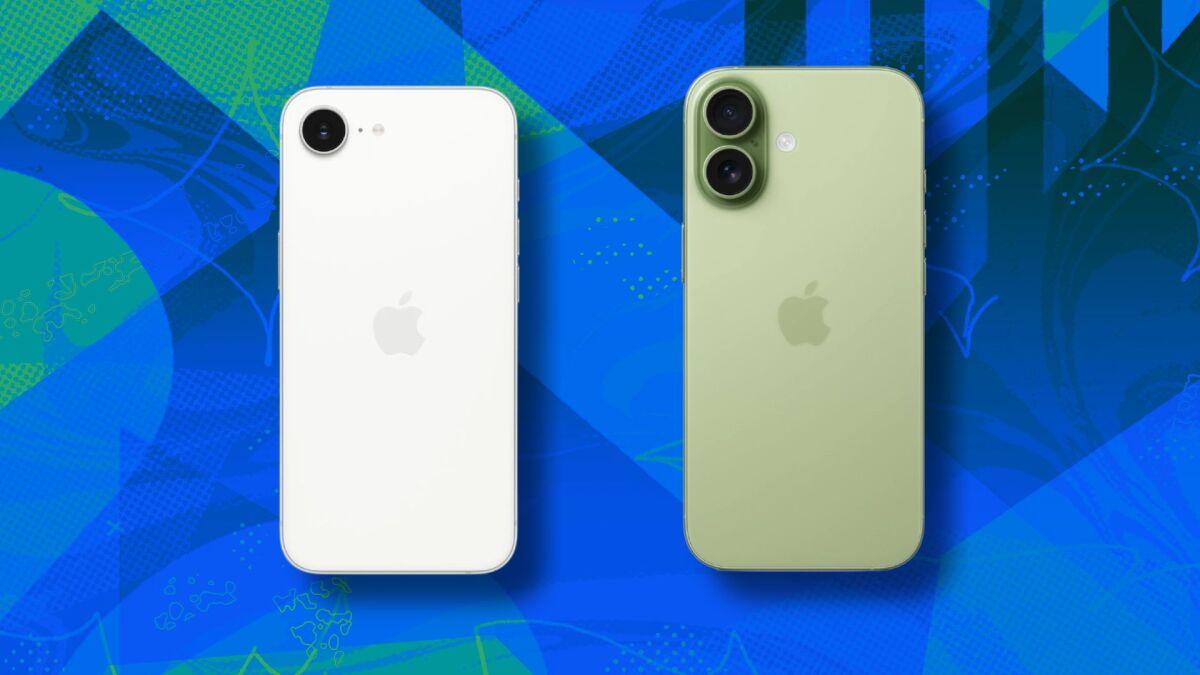
How much are you saving (and sacrificing) if you pick the newly announced iPhone 17e over the regular version?
By

Chance Townsend
Assistant Editor, General Assignments
Chance Townsend is the General Assignments Editor at Mashable, covering tech, video games, dating apps, digital culture, and whatever else comes his way. He has a Master's in Journalism from the University of North Texas and is a proud orange cat father. His writing has also appeared in PC Mag and Mother Jones.
on

We've started calling the iPhone 17e (left) the Cyclops. Credit: Mashable Photo Composite / Apple
Apple's latest budget iPhone is here, and you're faced with a classic dilemma: Do you splurge on the iPhone 17 (starting at $799), or is the more wallet-friendly iPhone 17e ($599) good enough?
Sure, they share some DNA — including the exact same A19 chip — but make no mistake: these two devices have key differences that could make or break your decision. We're talking price, design, display tech, battery life, and, of course, camera prowess.
At $599, the iPhone 17e is the budget-friendly model that delivers a surprising number of flagship features, while the iPhone 17 gets you some real upgrades — but are those upgrades actually worth $200?
Let's break it all down.
iPhone 17e vs iPhone 17: Price and specs

The iPhone 17. Credit: Stan Schroeder / Mashable
At $799, the iPhone 17 comes with the following specs:
A19 chip with 5-core GPU
256GB of storage
6.3-inch display with ProMotion (120Hz)
Always-On display
Dynamic Island
Camera Control button
Action button
MagSafe wireless charging up to 25W
Meanwhile, the iPhone 17e packs nearly the same internals at $599. Here are the specs:
A19 chip with 4-core GPU
256GB of storage
6.1-inch display (60Hz)
Standard notch
Action button
MagSafe wireless charging up to 15W
The most immediate difference between the iPhone 17e and iPhone 17 is the color selection — and it's significant. The iPhone 17 comes in five colors:
Black
White
Mist Blue
Sage
Lavender
The 17e is limited to:
Black
White
Soft Pink
If variety matters to you, the 17 has the clear edge.
Both phones share an aluminum design with Ceramic Shield 2 on the front, but the iPhone 17 weighs slightly more at 6.24 ounces versus the 17e's 5.96 ounces. The 17e is also a touch more compact overall (6.1 inches versus 6.3 inches), which some people will actually prefer.
The bigger design story, though, is what the 17e is missing: Dynamic Island. The iPhone 17e sticks with the traditional notch, while the iPhone 17 features Apple's pill-shaped interactive cutout that doubles as a live notification hub. If Dynamic Island has become something you rely on, that's a real trade-off.
Mashable Light Speed
iPhone 17e vs iPhone 17: Display

The iPhone 17e lock screen and Dynamic Island. Credit: Apple

The iPhone 17 cut-out design. Credit: Apple
When it comes to displays, the gap is more noticeable than it looks on paper. Both phones feature a Super Retina XDR OLED panel with 460 ppi and standard Apple perks like True Tone, Wide Color (P3), and Haptic Touch. But the similarities start to fade fast.
The iPhone 17 has a larger 6.3-inch screen with ProMotion adaptive refresh rates up to 120Hz and an Always-On display — features the 17e simply doesn't have. The 17e runs at a standard 60Hz on its 6.1-inch panel.
Brightness is another gap. The 17e tops out at 800 nits typical and 1,200 nits HDR. The iPhone 17 cranks up to 1,000 nits typical, 1,600 nits HDR, and a blazing 3,000 nits outdoors. If you spend a lot of time in bright sunlight, that difference is very real.
If you're all about a smoother, brighter, more dynamic display, the iPhone 17 has a meaningful edge. Otherwise, the 17e's screen is still excellent by any standard.
iPhone 17e vs iPhone 17: Cameras
This is where things get interesting — and a little complicated. The iPhone 17e has a single lens on the back but uses Apple's 2-in-1 camera system, combining a 48MP wide-angle and a 12MP 2x Telephoto in one.
iPhone 17e:
48MP Fusion Main camera (26mm, f/1.6)
12MP 2x Telephoto
Digital zoom up to 10x
Night mode, Portrait mode, Photographic Styles
12MP TrueDepth front camera
iPhone 17:
48MP Fusion Main camera (26mm, f/1.6)
12MP optical-quality 2x Telephoto (52mm)
48MP Fusion Ultra Wide (13mm, 120° FOV)
4x optical zoom range
Digital zoom up to 10x
48MP macro photography
Spatial photos and Spatial video
18MP Center Stage front camera with autofocus
The iPhone 17's 48MP Ultra Wide lens is a meaningful upgrade — you get macro photography, spatial video recording, and a much wider field of view that the 17e simply can't match. The 17 also packs a next-gen 18MP front camera with Center Stage, compared to the 17e's 12MP TrueDepth. If photography is a priority, the iPhone 17 is the stronger pick.
That said, the 17e is no slouch. For most everyday shooting — portraits, landscapes, and social media — it delivers results that would have been considered flagship-quality not long ago.
iPhone 17e vs iPhone 17: Performance

Credit: Stan Schroeder / Mashable
Here's a genuine surprise: the iPhone 17e and iPhone 17 are powered by the exact same A19 chip with a 6-core CPU and 16-core Neural Engine. The only difference is the GPU — the iPhone 17 has a 5-core GPU, while the 17e has a 4-core GPU.
In real-world use, you're unlikely to notice that gap unless you're doing heavy gaming or GPU-intensive tasks. Day-to-day performance — app launches, multitasking, Apple Intelligence features — will feel essentially identical on both devices.
The 17e also packs Apple's new C1X modem, which is reportedly twice as fast as the C1 found in its predecessor, the iPhone 16e. Both phones support 5G, though the iPhone 17 adds mmWave 5G support and Wi-Fi 7, while the 17e tops out at Wi-Fi 6.
iPhone 17e vs iPhone 17: Battery Life
Apple's battery test clocked the iPhone 17e at up to 26 hours of video playback. The iPhone 17, despite its larger size, comes in at up to 30 hours. So the 17 does have the edge here, but the 17e's 26 hours is genuinely impressive and likely more than enough for most users.
Fast charging also differs slightly. The iPhone 17 can hit 50 percent in 20 minutes with a 40W adapter, while the 17e reaches 50 percent in 30 minutes with a 20W adapter. Both are MagSafe-enabled — a first for the budget line — but the 17 supports faster MagSafe charging at 25W versus the 17e's 15W.

Assistant Editor, General Assignments
Chance Townsend is the General Assignments Editor at Mashable, covering tech, video games, dating apps, digital culture, and whatever else comes his way. He has a Master's in Journalism from the University of North Texas and is a proud orange cat father. His writing has also appeared in PC Mag and Mother Jones.
In his free time, he cooks, loves to sleep, and greatly enjoys Detroit sports. If you have any tips or want to talk shop about the Lions, you can reach out to him on Bluesky @offbrandchance.bsky.social or by email at [email protected].


 English
 Arabic
 French
 Spanish
 Portuguese
 Deutsch
 Turkish
 Dutch
Dutch
 Italiano
 Russian
 Portuguese (Brazil)
 Greek
Greek