


Lera August/Shutterstock
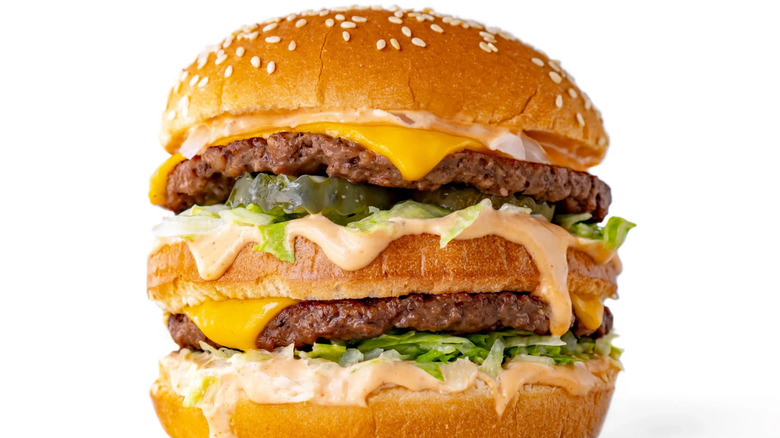
In the grand pantheon of fast food burgers, the McDonald's Big Mac is one of the most recognizable in the world. The towering Big Mac is one of the fast food items that has been around longer than you may realize. If you were not old enough to experience its iconic jingle in the 1970s, even casual fans of fast food might know of the "two all-beef patties, special sauce, lettuce, cheese, pickles, onions, and a sesame seed bun" immortalized in the jingle's lyrics. The burger was invented in the 1960s by a McDonald's franchise owner, Michael James "Jim" Delligatti, to compete with the sales of similar burgers offered by other chains, like Burger King's Whopper. McDonald's company executives were reportedly reluctant to approve this burger, which was certain to be much more expensive. Sales numbers said otherwise, after the Big Mac was well-received at its launch in a Uniontown, Pennsylvania, franchise owned by Delligatti. It was added to McDonald's menus nationwide the following year and has remained one of the most popular fast food burgers on the planet.
The Big Mac is so well-known that it is almost synonymous with the McDonald's brand, appearing as a standard menu item at locations worldwide, along with other favorites like its World Famous Fries and Chicken McNuggets. McDonald's branches in India, a country with a Hindu majority population that is often vegetarian, have a plant-based version called the Veg Maharaja Mac, which incorporates patties made of corn and cheese. McDonald's India even has its own version of the Big Mac special sauce that contains habanero peppers.
Why is McDonald's Big Mac so special?
usaphoto/Shutterstock
India is not the only country in which McDonald's has tweaked the constituent parts of a Big Mac to cater to the tastes of the local population. A Chicken Big Mac was offered in several countries including Egypt and Pakistan in the 2010s, where breaded chicken patties take center stage instead of beef. In 2009, there was a Mega Tamago Mac offered in Japan, where a fried egg and an extra beef patty were added. There were also the various size options you could get of the Big Mac over the years. The Double Big Mac, where there are four beef patties instead of two for those really hankering for some meat, is still available in Canada and also during promotional periods in other markets like Indonesia. Conversely, if you do not have as much of an appetite, a smaller version called a Mac Jr is available in Australia and the U.K., where the burger does away with the middle bun and uses just one, larger beef patty instead. It is also not a big secret at McDonald's that you can customize virtually any burger, so perhaps a Filet-O-Fish with a Big Mac Sauce experiment may be in your future!
With the proliferation of Big Mac in different countries around the globe, it has even had an impact on world economics. In 1986, The Economist invented "the Big Mac Index" as a way to compare purchasing power between consumers in different countries. And thus, the term "burgernomics" was born.

 English
 Arabic
 French
 Spanish
 Deutsch
 Turkish
 Dutch
Dutch
 Italiano
 Russian
 Romaian
 Portuguese (Brazil)
 Greek
Greek