


US Automotive Glass Fiber Composite Market Forecast 2025–2031 with Focus on Lightweight Vehicle Innovation
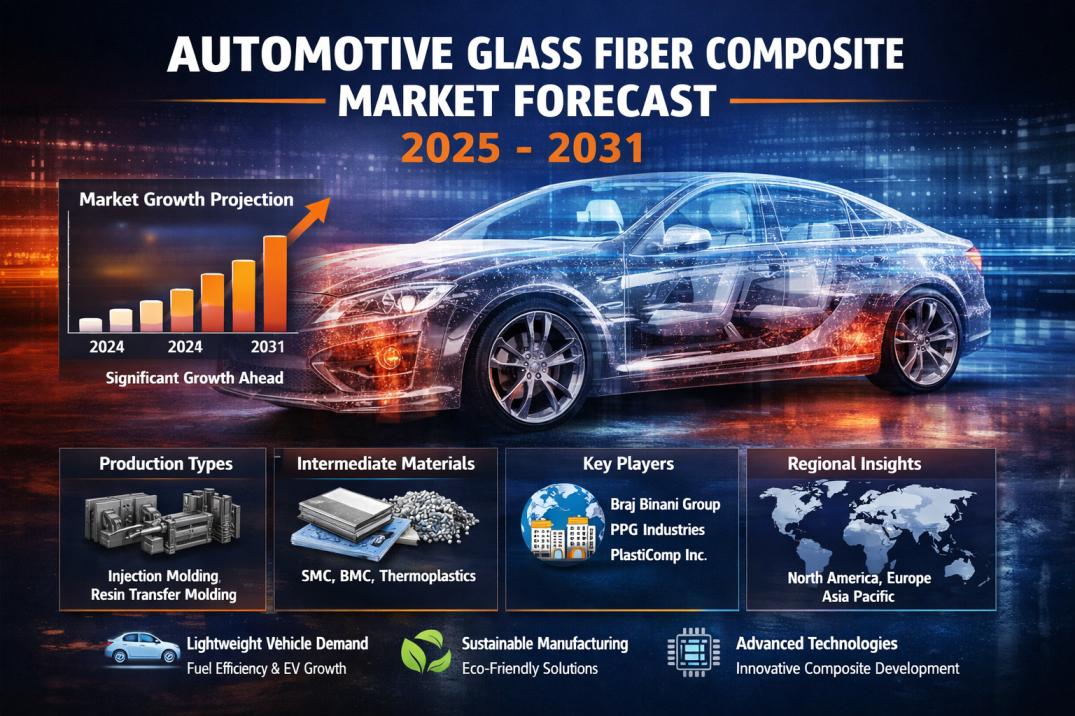
The Automotive Glass Fiber Composite refers to the global sector engaged in the development, manufacturing, and application of glass fiber–reinforced composite materials for automotive use. These materials are formed by combining glass fibers with a polymer resin matrix, creating high-performance composites that deliver improved strength, rigidity, impact resistance, and reduced weight. Automotive companies increasingly adopt these composites to enhance fuel efficiency, lower emissions, and maintain structural safety standards while supporting modern vehicle design requirements.
The Automotive Glass Fiber Composite Market is projected to grow steadily from 2025 to 2031, supported by the rising demand for lightweight vehicle components, eco-friendly manufacturing practices, and continuous advancements in composite processing technologies. Automotive OEMs are expanding the use of glass fiber composites across exterior panels, interior trims, structural frameworks, and engine compartment components to improve performance, durability, and overall vehicle efficiency.
Market Segmentation Analysis
The Automotive Glass Fiber Composite Market is segmented based on Production Type and Intermediate Material.
By Production Type
-
Hand Layup
-
Resin Transfer Molding
-
Vacuum Infusion Processing
-
Injection Molding
-
Compression Molding
Compression molding and injection molding are gaining strong traction due to their scalability and suitability for high-volume automotive production. Resin transfer molding and vacuum infusion processing are preferred for complex structural components requiring enhanced mechanical properties.
By Intermediate Material
-
Sheet Molding Compound
-
Bulk Molding Compound
-
Glass Mat Thermoplastic
-
Short Fiber Thermoplastic
-
Long Fiber Thermoplastic
-
Continuous Fiber Thermoplastic
-
Phenolic Molding Compound
Sheet Molding Compound and Bulk Molding Compound remain dominant due to their versatility in automotive body panels and structural components. Continuous Fiber Thermoplastics are witnessing increasing adoption for high-performance lightweight applications.
Sample PDF:- https://www.theinsightpartners.com/sample/TIPTE100000999
Growth Drivers of the Automotive Glass Fiber Composite Market
Innovative materials are significantly boosting automotive performance and safety. Manufacturers are investing in advanced composite formulations that enhance crash resistance and thermal stability.
Sustainable manufacturing practices are driving eco-friendly vehicle production. Automotive companies are focusing on recyclable composite solutions and reduced carbon emissions across production lines.
Rising demand for lightweight solutions is enhancing fuel efficiency and extending electric vehicle battery range. Glass fiber composites help reduce vehicle weight without compromising structural strength.
Competitive Landscape and Key Players
The Automotive Glass Fiber Composite Market features a competitive environment with both global and regional manufacturers expanding their product portfolios and technological capabilities.
Key Players:
-
Braj Binani Group
-
Fibre Glass Industries
-
Jiangsu Changhai Composite Materials Co., Ltd.
-
Kemrock Industries and Exports Limited
-
Lintex International Company Ltd.
-
PlastiComp, Inc.
-
PPG Industries, Inc.
-
Smart Material Corp.
-
ZCL Composites Inc.
These companies focus on strategic partnerships, product innovation, capacity expansion, and regional market penetration to strengthen their competitive positioning.
Regional Insights
North America is witnessing strong adoption due to stringent fuel efficiency regulations and growing electric vehicle production. The US automotive sector is increasingly integrating glass fiber composites into lightweight vehicle platforms.
Asia Pacific is emerging as a high-growth region driven by expanding automotive manufacturing in China, India, and Japan. Europe continues to emphasize sustainability and advanced material adoption in automotive engineering.
What factors are driving the Automotive Glass Fiber Composite Market growth?
The market growth is driven by increasing demand for lightweight vehicles, rising electric vehicle production, advancements in molding technologies, and sustainability initiatives in automotive manufacturing.
Which production type segment holds significant importance in the Automotive Glass Fiber Composite Market?
Compression molding and injection molding hold significant importance due to their efficiency in mass production and ability to produce high-strength automotive components.
Why is the US Automotive Glass Fiber Composite Market gaining attention from investors?
The US market is gaining attention due to strong automotive innovation, electric vehicle adoption, regulatory support for fuel efficiency, and investments in advanced composite technologies.
Future Outlook
The future outlook for the Automotive Glass Fiber Composite Market remains promising as automakers intensify their focus on lightweight materials, electrification, and sustainable production. Continuous advancements in thermoplastic composites and smart material integration are expected to reshape automotive design strategies. Increasing collaboration between composite manufacturers and automotive OEMs will further accelerate innovation and expand application scope across next-generation vehicles.
Related Report:- Food and Beverage Metal Cans Market Research Report by Size Share Analysis 2031

 English
 Arabic
 French
 Spanish
 Deutsch
 Turkish
 Dutch
Dutch
 Italiano
 Russian
 Romaian
 Portuguese (Brazil)
 Greek
Greek