




Kelvn/Getty Images
In our modern world, there are so many things that you can purchase from a vending machine, and several untold truths about vending machines themselves. While snacks and drinks might be what most of these quick-service devices provide, you can buy anything from hot coffee to soft serve ice cream, and from protective equipment to cars by pushing a button or two. If you think this modern marvel is a product of the 20th century, think again. The very first documented apparatus that dispensed an item from a free-standing compartment after it was paid for was invented in the first century A.D. It gave people water, but not in the plastic bottles the U.S. loves so much; this one was for selling holy water.
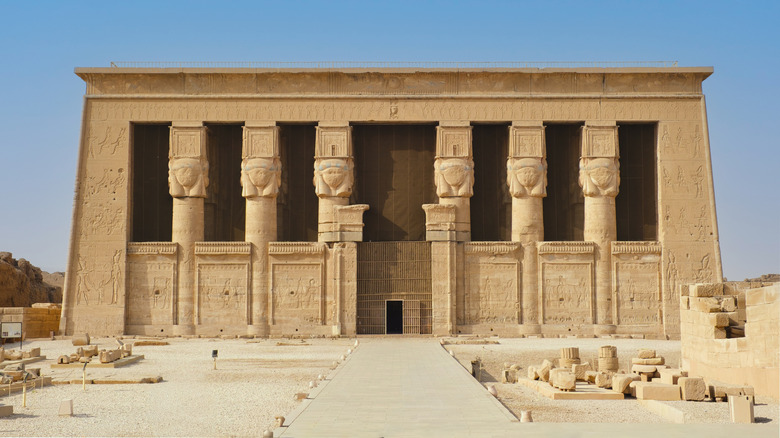
A Greek engineer and mathematician named Heron of Alexandria (also known as Hero) was hired by an Egyptian temple to construct a machine that could regulate the amount of holy water temple-goers could access. This water wasn't necessarily used like the holy water in Catholic churches today (for baptisms or dipping your fingers in before you cross yourself). Water in ancient Egypt symbolized several spiritual ideals, like purity and renewal, and people would pour water as an offering to ancestors or temple gods. Apparently, some people would pour more water than they were paying for, and there wasn't an effective regulation process to ensure this wouldn't happen. Heron's invention put that regulation in place.
How the holy water vending machine worked and how it evolved
Vlad Antonov/Shutterstock
Heron's holy water vending machine contained a type of water cistern placed inside a box. To access the water, worshippers had to drop a coin into the top of the box, which would fall inside onto a lever attached to a plug obstructing the water flow. As the coin's weight pushed the lever down, the plug would lift up, allowing water to escape into whatever vessel the worshipper had. When the coin dropped off the lever, the plug would fall into place again, stopping the water. It was quite a feat of engineering at the time, and probably led a lot of people, unable to see the machine's inner workings, to wonder, "How does it do that?" In basic terms of form and function, it's like any vending machine today: pay up, and receive a regulated amount of what you purchased.
It's unknown just how many temples utilized this ingenious novelty of Heron's, but we know that Alexandria, Egypt, was home to many temples of different faiths. It does appear that the holy water vending machine concept was scrapped as time progressed. Eventually, a version of Heron's invention resurfaced in 17th-century England, where coin-operated tobacco devices were used, typically in taverns. From there, machines began sprouting up over generations, selling stamps and gum in the 19th century, candy bars and soda in the 20th century, and bottles of Champagne in the 21st. If you can believe it, a burger vending machine now exists – it debuted in Jersey City, New Jersey, in 2020.

 Arabic
 French
 Spanish
 Portuguese
 Deutsch
 Turkish
 Dutch
Dutch
 Italiano
 Russian
 Romaian
 Portuguese (Brazil)
 Greek
Greek