


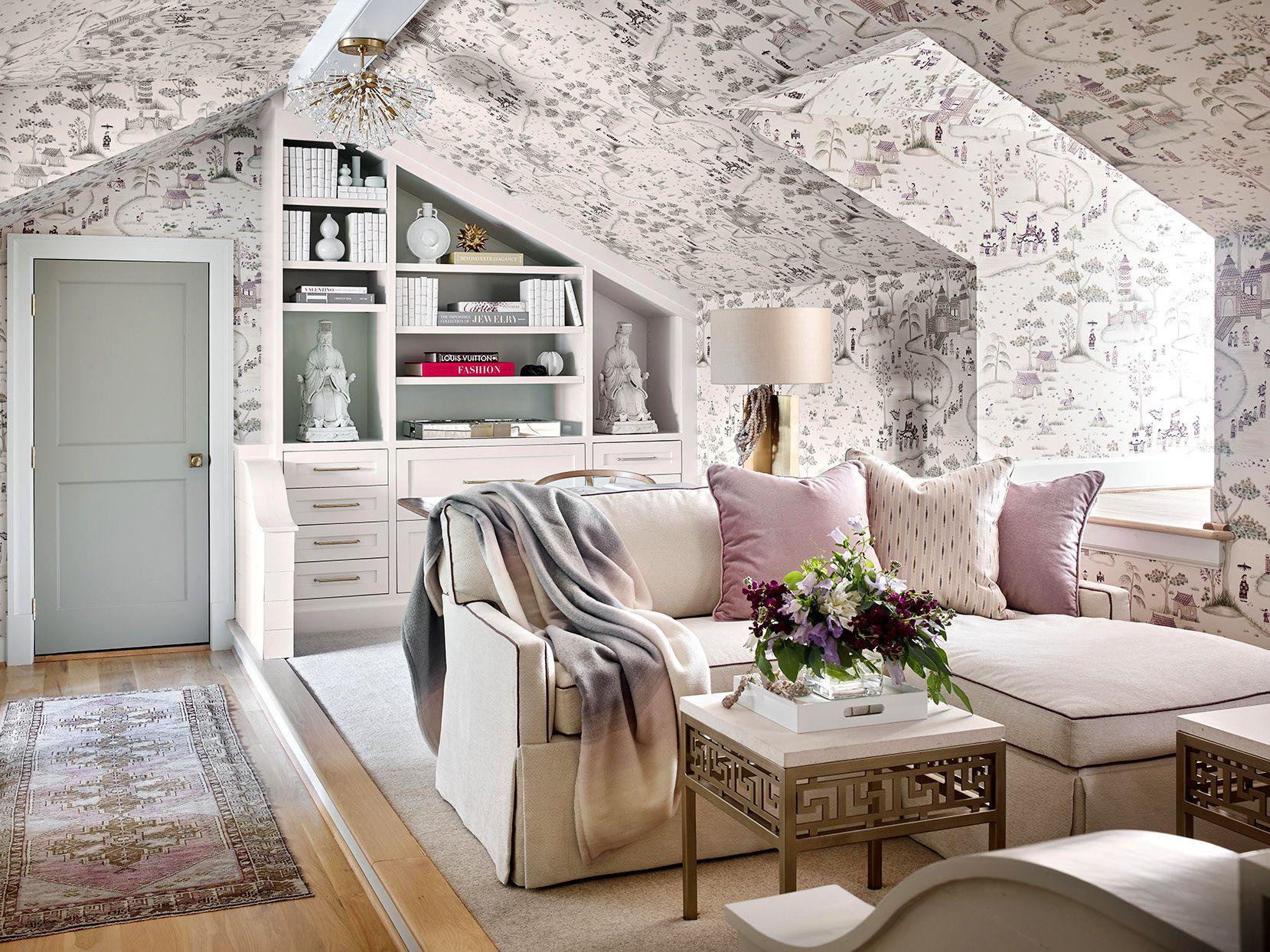
The wallpaper trends of 2026 center on creating a sense of depth or history in your home. This approach works for both maximalists and minimalists, as you can do something bold like mixing two patterns in one room or go subtle with a plaster-look in another. Both directions add depth and interest to a room, which you can build on with furniture and decor.
This focus on an overall design story enables sophisticated, creative wallpaper applications that will outlive the trend cycle. Read on to hear what wallpaper trends designers predict will take over in 2026.
- Elizabeth Rees is the co-founder of Chasing Paper, a design-forward wall coverings company.
- Lonni Paul is the founder and principal designer of Lonni Paul Design.
Edmund Bar
1. Print Layering
"Print layering (combining multiple patterns) is the latest trend for mixing patterns and textures to curate spaces that feel personal," says Elizabeth Rees, co-founder of Chasing Paper.
There are many ways to approach this layering technique. ’80s and ’90s kids will remember the look of two wallpapers divided by a chair rail; to replicate this look in a more modern way, choose a large print for the bottom and a small one for the top. Similarly, you could install a large print on the walls and a petite one on the ceiling, or pair an organic print with a geometric one.
Regardless of how you mix papers, the most important thing is to make sure the color schemes work well together. Always grab some samples, so you can really examine the undertones of each print.
Max Kim-Bee
2. Trompe L’oeil Wallpapers
Wallpapers that mimic a 3-D or textured surface, such as plaster, stone, or wood, can transform a room into something more grand without a construction project. Faux texture or "trompe l'oeil" wallpapers address how things feel, not just how things look, which is increasingly important in interiors, according to Lonni Paul, founder and principal designer of Lonni Paul Design.
To make the most of this type of print, Paul recommends using a faux plaster wallpaper as an elegant background for a furniture or art collection. Wood and wood veneer wall coverings make great feature walls or add coziness to dens or libraries.
Related
Michael Partenio
3. Neutral, Natural Texture
Bringing nature indoors is a key function of wallpaper, and in 2026, people are taking this idea literally.
"People want surfaces you can see and feel, not just visual prints, Paul says. This includes wallpapers made from textured natural surfaces: think linen, sisal, even fabric or enhanced-fiber surfaces. According to Paul, these more literal natural wall coverings align with the push toward craftsmanship and slow design.
"It gives design flexibility," Paul says. "Texture can serve as a subtle backdrop, allowing furniture, art, and objects to stand out."
KIM CORNELISON
4. Embossed Wallpaper
Embossed wallpaper is a more decorative version of the texture people crave, allowing for more formal styling. Embossed papers have a pattern imprinted on them, creating a dimensional surface that adds subtle variations in light and shadow to the design.
"It turns the wall into a surface you want to touch, making it feel like part of the design material rather than just a background. It offers dramatic impact without necessarily being loud in pattern—texture becomes the pattern," Paul says.
5. Block Print
Block printing dates back to 3500 B.C., making it a truly timeless style. Often featuring florals, this traditional printing method became popular in the 1500s. And while block prints have been on trend for a while now, designers are doubling down on this historic look in 2026.
"Our prediction is that this trend will continue to evolve," Rees says. "Block prints are a great way to bring subtle patterns into a smaller space without creating a cluttered feeling."
Rees says block prints are part of a family of wallpaper patterns that enhance a sense of history in the home. People who are trying to add depth to new builds or update suburban homes are finding success with patterns like block print that have been around for centuries. "We’re seeing people gravitate towards something that feels hand-drawn and with patina," Rees says.

 Arabic
 French
 Spanish
 Portuguese
 Deutsch
 Turkish
 Dutch
Dutch
 Italiano
 Russian
 Romaian
 Portuguese (Brazil)
 Greek
Greek