


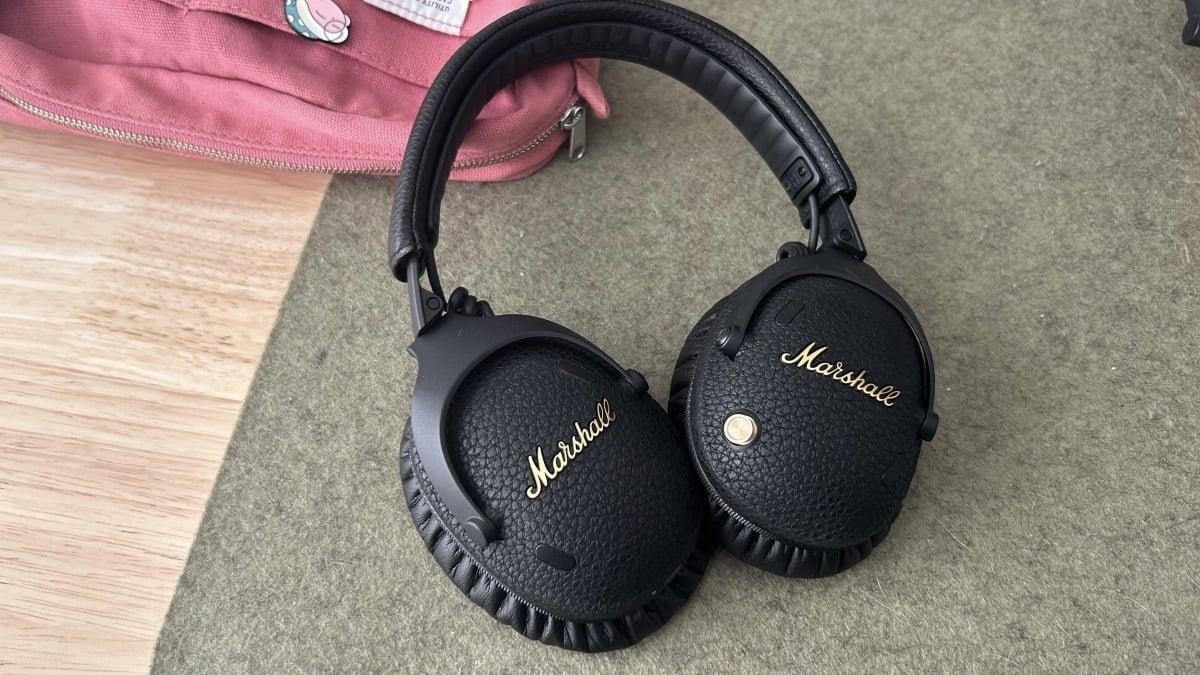
These retro-designed headphones sound as good as they look.
By

Bethany Allard
Lead Shopping Reporter
Bethany Allard is a Los Angeles-based shopping reporter at Mashable covering beauty tech, dating, sex and relationships, and headphones. That basically means she puts her hair through a lot, scrolls through a lot of dating apps, and rotates through a lot of different headphones. In addition to testing out and rounding up the best products, she also covers deals for Mashable, paying an especially obsessive amount of attention to Apple deals and prices. That knowledge comes in handy when she's covering shopping holidays like Prime Day and Black Friday, which she's now done for three years at Mashable.
on
All products featured here are independently selected by our editors and writers. If you buy something through links on our site, Mashable may earn an affiliate commission.

Gorgeous and functional — what more could you want? Credit: Bethany Allard / Mashable
It's no secret that Marshall has mastered the classic retro design. What is a secret is how good its noise-cancelling headphones, the Marshall Monitor III, are.
I have a few theories as to why these headphones fly under the radar. First and foremost, Marshall is more known for its speakers. Then there's the fact that other noise-cancelling brands like Sony, Bose, and Apple generally take the top spots on best-of lists (including ours). Finally, as mid-range headphones — which are neither class-leading nor the most affordable headphones out there — the Monitor III headphones simply get overlooked by reviewers and consumers alike. In short, their lack of obvious superlative power makes them the middle child of the headphone world (no offense intended to any middle children out there).

These headphones are more than just their good looks. Credit: Bethany Allard / Mashable
Despite all that, the Monitor III headphones are some of the best I've tried. After using them regularly for a few weeks, I'm impressed by how much Marshall gets right (where those aforementioned Bose and Sony headphones falter). Best of all, as a mid-range option, they sit under the $450+ flagship price range that's become normal, retailing for a more stomachable $379.99 at full price, or $279.99 if you can grab them on sale.
To be totally honest, going into the testing process, I was sure the look of these headphones would be their best feature — but let's get into why they're so much more than that, and how they've shifted my headphone worldview.

$279.99
at Amazon
$379.99
Save $100
The best on-ear controls I've ever tried
I don't care if this is a deeply unexciting point to start on; I need to talk about the Monitor III on-ear controls, which are the new Platonic ideal for all headphones from here on out.

The placement! The tactility! The perfection of these on-ear controls! Credit: Bethany Allard / Mashable
Marshall keeps it simple with three tactile controls: a multidirectional control knob, the M button, and the ANC button. The latter two are located on the end of the hinge of the right and left ear cup, respectively, making them easy to locate without looking. The M button can be programmed to perform a multitude of tasks, from activating Spotify Tap to switching between the two equalizer settings. The ANC button, as the name suggests, toggles between the noise-cancelling and transparency modes. Perfect, simple, no notes.

The app allows for plenty of customization on the M button. Credit: Screenshot / Marshall

And even with the ANC button. Credit: Screenshot / Marshall
The multidirectional knob, however, is the true star of the show, serving as the power button, volume control, and forward/backward button for music. Having encountered buttons on headphones that try to do too much (if we're long pressing and triple pressing, we've officially lost the plot), the knob accomplishes the versatility by shifting entirely up and down, or side to side. No finicky touch controls or sliders, no triple presses, just the audio playback performing as it's supposed to.
As much as I enjoyed it, I wasn't too surprised to encounter this knob mechanism — I had seen it before when testing a Marshall speaker.
Incredibly customizable, from ANC to spatial audio
As you may have gleaned from my ode to the touch controls, the Marshall companion app lets you customize so much of these headphones.
Mashable Light Speed
In addition to setting the buttons, there are standard features like an equalizer and toggling the auto-play on and off (for the latter, I chose off — the wear detection is admittedly a little laggy on these headphones).

The Marshall companion app allows for plenty of customization. Credit: Screenshot / Marshall

Credit: Screenshot / Marshall
However, the Marshall app offers even more: There's a standby timeout option both for when the headphones aren't playing and for when they're not connected. The time can be set from zero to seven hours in increments of an hour, and zero to 55 minutes, in increments of five minutes, offering plenty of flexibility.
Then, there's the battery preservation settings, the adjustable ANC, and the soundstage option. (As an aside, the ANC is solid — certainly not the best out there, but it does the job). The last on that list is Marshall's spatial audio setting — rather than offering options for listening while you're still or on the move, Marshall's app lets you set the size of the "room" the sound will take up, as well as the amount of the soundstage you want, from 10 to 100 percent. In all the headphones I've tested, I've never encountered this level of customization for spatial audio features.

The standby settings and soundstage settings are where the Monitor III headphones really start to stand out. Credit: Screenshot / Marshall

Credit: Screenshot / Marshall
As a bonus, the app is easy to navigate, consistently branded with the look of the headphones, and features just the right amount of detail. For instance, when selecting the equalizer setting as the M-button preset, the app clearly shows what two equalizer settings are currently in place. Similarly, in the battery preservation screen, toggling the slider from none to max clearly shows which features are activated at each level of preservation.

Customization feels intuitive, with settings populating where you'd expect. Credit: Screenshot / Marshall

You'd be surprised how many companion apps aren't this straightforward. Credit: Screenshot / Marshall
Sound balance that doesn't lean too bass-heavy (finally)
I test a lot of headphones, and generally, I find that audio products tend to conflate "balanced" audio with audio that predominantly features bass. As someone who prefers a more mid-heavy mix, the Monitor III headphones felt like the audio match I've been looking for.
Though the custom equalizer allows you to filter between the five presets or opt for a custom mix, I was often most happy with the Marshall preset out of the box. The Korean pop-rock band Day6's hit "You Were Beautiful" felt made for these headphones, with sweeping vocals, electric guitar, and bass guitar especially standing out (plus a touch of piano in the verses). Similarly, the end of Billie Eilish's "Happier Than Ever" sounded angsty and crunchy in the best way possible (where a distorted guitar emphasizes the anger of the song). Considering Marshall's branding, it's unsurprising that more rock-heavy songs sounded especially great.
That said, softer strings sounded just as lovely. The finger-plucking of the acoustic guitar in Liana Flores' "recently" sounded crystal clear, making me feel like I was listening to an intimate performance in a cafe. In the same vein, Ebony Loren's take on the bossa nova classic "O Pato" sounded especially bouncy and playful in its quick guitar pattern, clear vocals, and trumpet solo.
That's not to say these are the best headphones I've ever used. Though they do a decent job, these aren't the headphones to best enjoy house music or EDM. More generally speaking, they can also lean a bit flat, lacking the depth of those premium Bose or Sony options — but for the price gap, the difference is warranted.
Wear comfortably while looking stylish
Last but not least, let's tackle the design of these headphones. Marshall made a gorgeous product with the Monitor III, from the pebbled ear cup, the gold accents of the name (Dyson could take some notes on how to do branding right), and the touch of exposed wiring.

In my humble opinion, these headphones simply look better than most others out there! Credit: Bethany Allard / Mashable
It won't be to everyone's aesthetic, but I far preferred this unique design over the recently released Nothing Headphones. Plus, though the Marshall ear cups are on the lower-profile side, I found the give of their headband and the padding of the ear cushion to be far more comfortable than the Nothing headphones, and more akin to something like the Bose QuietComfort headphones. The result? Headphones that wear as well as they look.
The comfort of these headphones makes them great for a longer wear time — which is great news, considering they offer 70 hours of battery life with ANC, far outperforming most other models by at least 30 hours, and our current favorite headphones for battery life, the Sennheiser Momentum 4, by 10 hours.
A mid-range contender to be reckoned with
Are they perfect headphones? No. But if you don't need class-leading sound and ANC and can make do with both of those being just pretty good instead, the Monitor III headphones pick up the slack in areas where the most popular headphones overlook.
Their design is unique, but actually functional, their tactile controls are the best I've tried, and their customization is hard to beat. Even with their price being on the higher end of the mid-range scale, they're worth picking up — but especially if you can grab them on sale.
$279.99
at Amazon
$379.99
Save $100

Bethany Allard is a Los Angeles-based shopping reporter at Mashable covering beauty tech, dating, sex and relationships, and headphones. That basically means she puts her hair through a lot, scrolls through a lot of dating apps, and rotates through a lot of different headphones. In addition to testing out and rounding up the best products, she also covers deals for Mashable, paying an especially obsessive amount of attention to Apple deals and prices. That knowledge comes in handy when she's covering shopping holidays like Prime Day and Black Friday, which she's now done for three years at Mashable.


 English
 Arabic
 French
 Spanish
 Portuguese
 Deutsch
 Turkish
 Dutch
Dutch
 Italiano
 Romaian
 Portuguese (Brazil)
 Greek
Greek