


 PUBLISHED


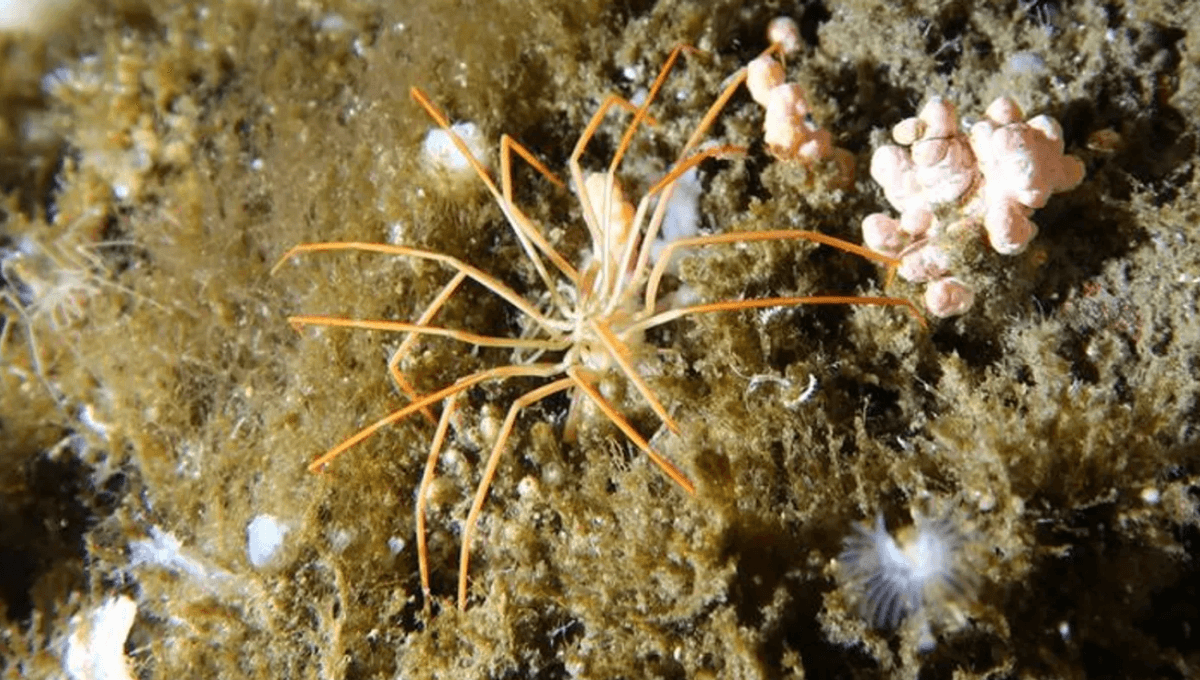
For 140 years, a leggy mystery has eluded scientists working in Antarctica. Here, you’ll find enormous sea spiders that are a great example of something called “polar gigantism”, a phenomenon where animals get supersized in cold environments compared to their warmer relatives. Weird thing is, despite their enormous size, nobody knew where they came from.
The rest of this article is behind a paywall. Please sign in or subscribe to access the full content. The mystery of Antarctic sea spider (Colossendeis megalonyx) reproduction has now been solved thanks to a team of University of Hawaiʻi at Mānoa scientists working at a remote research station. They were able to collect several sea spiders by hand and transported them to observation tanks. Doing so enabled them to see Antarctic sea spider eggs for the first time, and it revealed a curious difference compared to other sea spider species. While most sea spiders will carry their eggs until they’re ready to hatch, Antarctic sea spiders attach their eggs to the rocky seabed. These then develop over several months, and they’re really hard to see. That’s because the eggs become overgrown with a kind of microscopic algae that perfectly camouflages them. It’s so effective that the researchers say they could hardly see the eggs in the observation tanks even though they knew they were there. “We were so lucky to be able to see this,” said PhD student Aaron Toh in a statement. “The opportunity to work directly with these amazing animals in Antarctica meant we could learn things no one had ever even guessed.” The discovery ends a 140-year mystery as to how these sea spiders reproduce and suggests they could be a valuable research subject for investigating how paternal care evolved in sea spiders. “These giant sea spiders, the males do care for the young, but they do it differently and they do it in a much simpler way than the other sea spiders,” said Amy Moran, UH Mānoa School of Life Sciences professor. “So it may provide a kind of a look at the evolutionary bridge that leads to fathers taking care of their offspring.” The study is published in the journal Ecology.


 Arabic
 French
 Spanish
 Portuguese
 Deutsch
 Turkish
 Dutch
Dutch
 Italiano
 Russian
 Romaian
 Portuguese (Brazil)
 Greek
Greek