


Like Mars, Europa Has A Spider Shape, And Now We Might Know Why
Like Mars, Europa Has A Spider Shape, And Now We Might Know Why
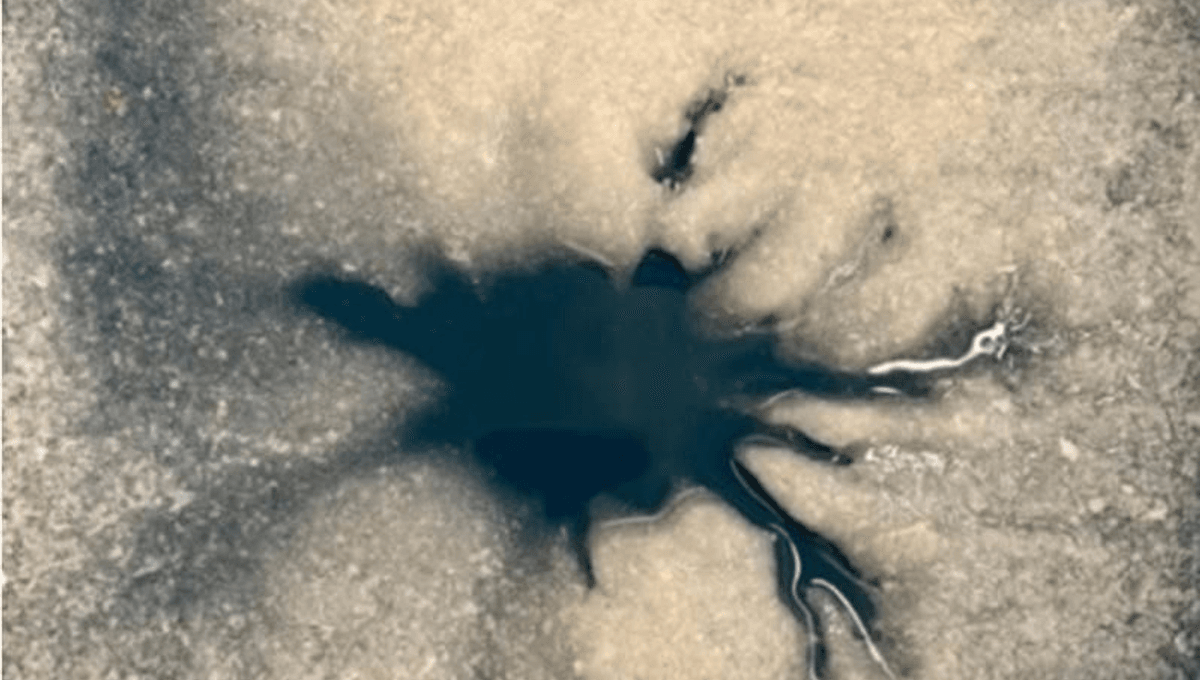
The Galileo spacecraft spotted a shape on Europa originally compared to an asterisk, but now seen more as a spider. Whatever you call it, scientists hope explaining the forces that produced this shape will help us understand the nature of Europa’s icy shell. Now some Earthly frozen lakes and experiments with liquid nitrogen might provide the answers they’re seeking.
The rest of this article is behind a paywall. Please sign in or subscribe to access the full content. Twenty-five years after David Bowie made The Spiders from Mars a cultural touchstone, disturbingly arachnid-like shapes were spotted by the Mars Orbital Camera near the Red Planet’s southern polar region. The European Space Agency’s ExoMars Trace Gas Orbiter brought them to the world’s attention in 2024. A long-standing explanation attributes the phenomenon to dust, carried by carbon dioxide exploding through translucent layers of ice after being turned to gas by sunlight. Lab experiments published last year add evidence to the that theory. No one has made a hit album about spiders from Europa, which might be why a similar-looking shape there hasn’t attracted the same attention, but it could be at least as scientifically significant. This shape, located in Manannán Crater, lacks the numbers of the Martian counterparts, but makes up for that in longevity, surviving for decades where the Martian spiders appear each spring and vanish soon after. Professor Lauren Mc Keown of the University of Central Florida led the lab work explaining the Martian spiders, and has turned her attention to the one on Europa. She and co-authors called the shape Damhán Alla (an Irish term for spider) and offer an explanation. Although they think Damhán Alla has some commonalities with the Martian spiders, Mc Keown and co-authors think there is more to learn from “lake stars” that form on Earth. The impact that created Manannán crater left plenty of heat behind, Mc Keown and co-authors reason. Salty water melted by this heat formed a lens beneath the ice, and as this started to freeze it expanded, cracking the ice above. The crack exposed the remaining brine to the vacuum of space, the authors propose, causing an eruption, and depositing a new layer of ice in the spider shape. Salts and reduced porosity made this new deposit much darker than the surrounding ice. “The significance of our research is really exciting,” Mc Keown said in a statement. “Surface features like these can tell us a lot about what’s happening beneath the ice. If we see more of them with Europa Clipper, they could point to local brine pools below the surface.” To test their thinking the team studied “lake stars” or “ice octopi” on frozen lakes, first described by Henry David Thoreau as part of the detailed weather observations which have since proven useful to climatologists in setting a baseline. In line with previous observations, lake stars near Breckenridge, Colorado form when a thin layer of ice on the lake is covered in enough snow for the weight to break the ice. Sometimes a solid object falling on the ice or warm water rising from below contribute to the puncture. Once the hole forms, warmer water rises from below the lake to reach the hole, sometimes creating brief fountains, and spreads to form the shape’s arms. When the ice refreezes, it forms a clear layer, allowing one to see the dark of the lake beneath the “star”, while surrounding it, the thicker ice is opaque. “Lake stars are really beautiful,” Mc Keown said, “and they are pretty common on snow or slush-covered frozen lakes and ponds. It is wonderful to think that they may give us a glimpse into processes occurring on Europa and maybe even other icy ocean worlds in our Solar System.” Professor Lauren Mc Keown beside an elongated lake star she thinks might be a model for Europa's spider shape. Image credit: Professor Lauren Mc Keown Mc Keown and the team then sought to make Damhán Alla replicas in the lab, using ice with grain sizes and salt concentrations matching those thought to exist on Europa. Their efforts were rewarded with what the team call “lab stars”, which look like much smaller versions of the lake stars they studied or the Martian spiders. The extent to which the arms branch depends on the grain size of the ice. We have yet to get images of Damhán Alla at high enough resolution to confirm how similar the shape is, but Europa Clipper should change that. This explanation conflicts with the initial hypothesis that Damhán Alla was composed of fractures of Europa’s icy crust. If the authors are right, it could tell us a lot about how thick Europa’s crust is, and therefore about how hard it would be for future missions to reach the internal ocean. Then again, some might argue the presence of giant spiders is a non-verbal way of sending a message like that of the aliens in the book and film 2010: “Attempt no landing there.” The study is published open access in The Planetary Science Journal..png "Professor Lauren Mc Keown beside a small and elongated lake star she thinks might be a model for Europa's spider shape.")

 Arabic
 French
 Spanish
 Portuguese
 Deutsch
 Turkish
 Dutch
Dutch
 Italiano
 Russian
 Romaian
 Portuguese (Brazil)
 Greek
Greek