


 PUBLISHED

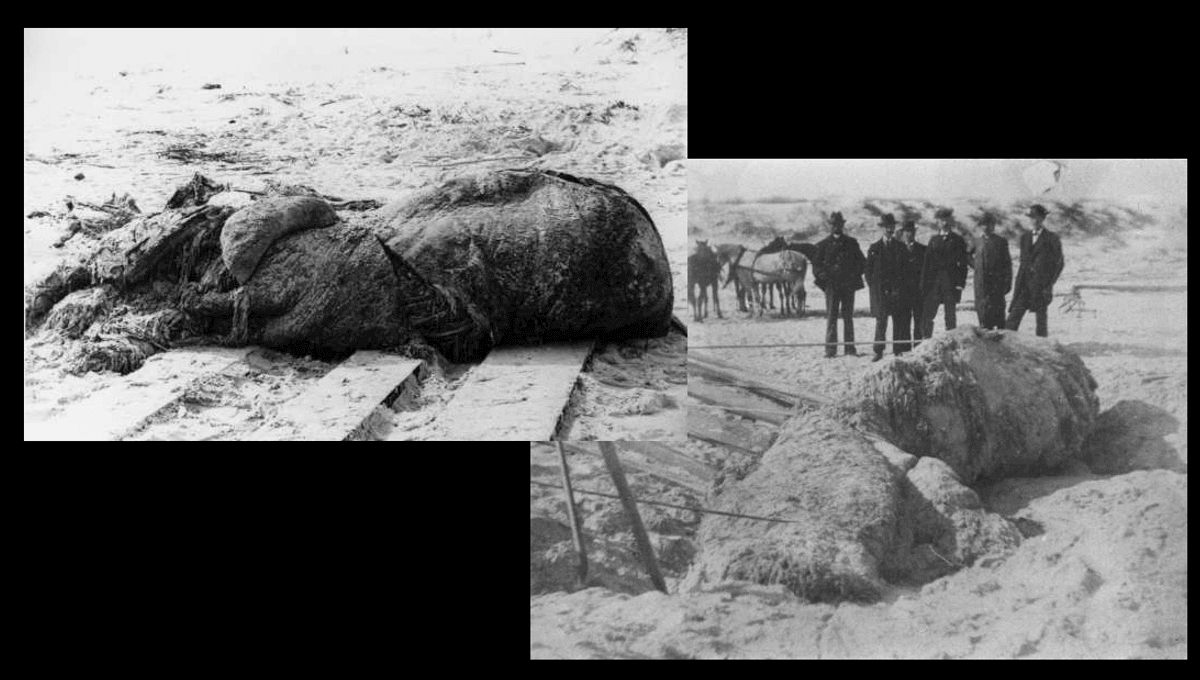
Imagine, if you will, you’re walking along the beach in the late 1890s when lo – what’s this? A great beast is sprawled across the sand, gelatinous and amorphous, stretching 5.5 meters (18 feet) long and 2.1 meters (7 feet) wide. A globular blob, and a real-life “globster” – the name given to a host of unidentified sea creatures that have washed up on beaches across the globe.
The rest of this article is behind a paywall. Please sign in or subscribe to access the full content. This was the fate of two boys strolling along Anastasia Island, Florida, in 1896. They pedaled off on their bikes to report their discovery and a day later were joined by Dr DeWitt Webb, founder of the St Augustine Historical Society and Institute of Science. Webb was stumped. The large mass of flesh appeared to have at least four mutilated limbs and a large, head-like region. He concluded it must be the remains of an enormous octopus-like creature and sent samples and photographs to Yale University. Suspecting that no such creature had ever been identified before, the St Augustine Monster was tentatively named Octopus giganteus by Yale’s Professor Addison Emery Verrill, an invertebrate zoologist. The new-to-science species would be short-lived, however, as upon investigating the samples Verrill decided that they were, in fact, the remains of a whale. The true identity of the St Augustine Monster continued to be debated for several decades as multiple follow-up analyses of the tissue sample were resubmitted to scientific journals. Then, in 2003, the arrival of another globster called the “Chilean Blob” offered up fresh samples that could be compared to those of the St Augustine Monster. Using electron microscopy, the 2004 study found that the Chilean Blob contained a network of cellulose comparable to that seen in whale blubber. DNA analyses also revealed a section of the mitochondrial gene that was an exact match to that of a sperm whale, Physeter macrocephalus. “These results unequivocally demonstrate that the Chilean Blob is the almost completely decomposed remains of the blubber layer of a sperm whale,” wrote the authors. “This identification is the same as those we have obtained before from other relics such as the so-called giant octopus of St. Augustine (Florida), the Tasmanian West Coast Monster, two Bermuda Blobs, and the Nantucket Blob.” “It is clear now that all of these blobs of popular and cryptozoological interest are, in fact, the decomposed remains of large cetaceans.” We’ve found many globsters since the St Augustine Monster sent those kids fleeing on their bicycles, not all of which turned out to be whales. In case you’re wondering how someone could question their identity, just check out the photos of this 8-meter (26-foot) long faceless blob with strange “teeth” that washed up in Wales not long ago.


 Arabic
 French
 Spanish
 Portuguese
 Deutsch
 Turkish
 Dutch
Dutch
 Italiano
 Russian
 Romaian
 Portuguese (Brazil)
 Greek
Greek