


“It’s An Incredible Feeling”: Salty Air Bubbles In 1.4-Billion-Year-Old Crystals Reveal Secrets Of Earth’s Early Atmosphere
“It’s An Incredible Feeling”: Salty Air Bubbles In 1.4-Billion-Year-Old Crystals Reveal Secrets Of Earth’s Early Atmosphere
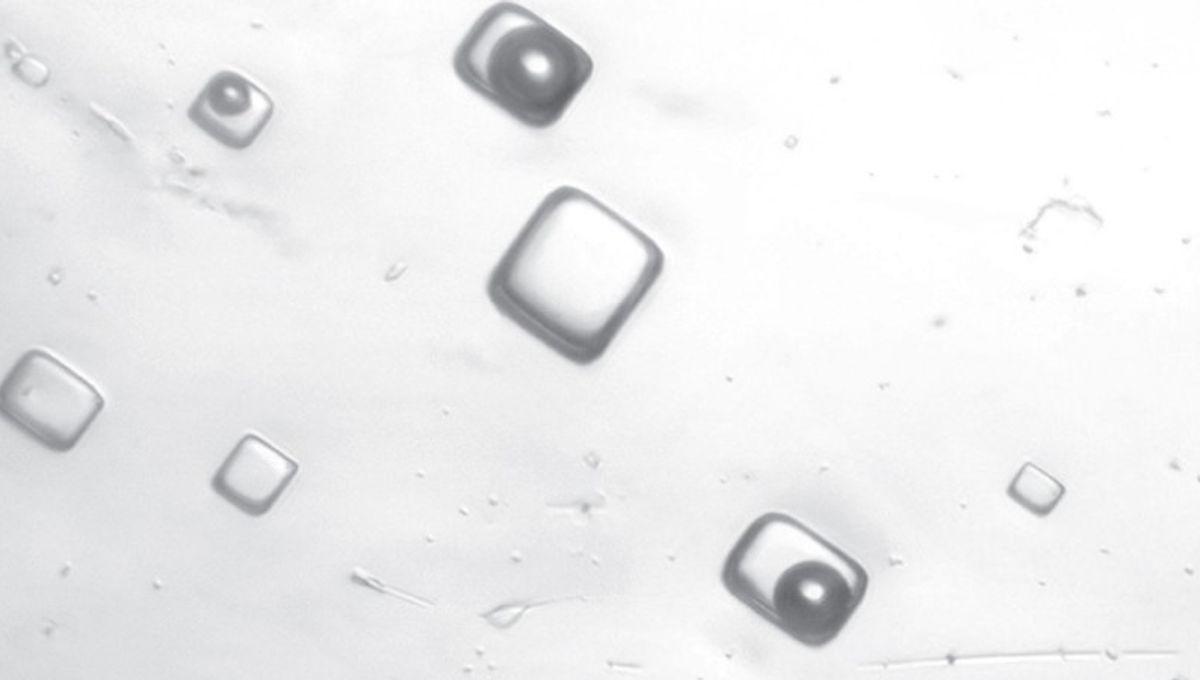
Salt crystals formed when a saline lake dried up 1.4 billion years ago trapped air inside, providing a sample of the atmosphere of the day, before photosynthesis was productive enough to make it oxygen-rich. New techniques have allowed that air to be analyzed accurately, providing insight into what to expect of an Earth-like planet’s atmosphere over most of its existence.
The rest of this article is behind a paywall. Please sign in or subscribe to access the full content. Geologists have named the period between 1.8 and 0.8 billion years ago the “boring billion” because not much seems to have happened in that time, only to be followed by a spectacular acceleration. Some, however, argue this billion was only boring because we don’t have the data on events laying the groundwork for an explosion of life. Rock salt from near Black Sturgeon Lake, Ontario, might change a few people’s minds. Back then, Canada was much closer to the equator, and this location experienced the fate of subtropical lakes without a major water source today, drying out frequently and leaving a layer of salt behind. The formation of salt crystals sometimes captures a drop of briny water inside, which can be accompanied by air bubbles. Scientists keen to understand the evolution of the atmosphere have seen the potential of salt crystals like these for a long time, but making the idea work has been something different. Instead of pure air, the bubbles are trapped with the briny water, which dissolves gases. Since some gases dissolve more easily than others, the presence of the water can make samples unrepresentative of the atmosphere as a whole. Professor Morgan Schaller of Rensselaer Polytechnic Institute has had equipment to address this problem custom-built in his lab. Graduate student Justin Park used it earlier this year to produce an atmospheric reconstruction of salt samples from 815 million years ago. Now Park, Schaller, and two colleagues have gone back another 600 million years. “The carbon dioxide measurements Justin obtained have never been done before,” Schaller said in a statement. “We’ve never been able to peer back into this era of the Earth’s history with this degree of accuracy. These are actual samples of ancient air!” “It’s an incredible feeling, to crack open a sample of air that’s a billion years older than the dinosaurs,” Park added. The work produced estimates of 0.78 percent oxygen and 0.28 percent CO2, compared to 20.0 percent and 0.04 percent today. The carbon dioxide concentration explains why the era has left little evidence of glaciation despite the fact that the Sun was 10-15 percent fainter than it is today. The salt itself also indicates a climate similar to today’s, which would certainly have required far more greenhouse gases than we have now, given the lower sunlight. The oxygen levels are more surprising. Although a mountain climber can tell you humans could not breathe air like this, it’s thought to have been enough to support the earliest animals, as well as providing a thin protective ozone layer. That would fit with the still very uncertain discovery of complex life dating to 2.4 billion years ago, but leaves open the question of why the first animals apparently didn’t emerge for another 600 million years or so. Many attempts to explain why life passed significant checkpoints when it did have assumed our animal ancestors appeared almost as soon as there was oxygen to support us. Park says we can’t answer that question without more data. "[The sample] may reflect a brief, transient oxygenation event in this long era that geologists jokingly call the 'boring billion,” he said. “Having direct observational data from this period is incredibly important because it helps us better understand how complex life arose on the planet, and how our atmosphere came to be what it is today,” Park added. The crystals were deposited around the time red algae, which are major producers of oxygen today, first evolved, and may reflect their oxygen production. The study is published in Proceedings of the National Academy of Sciences.

 English
 Arabic
 French
 Spanish
 Portuguese
 Deutsch
 Turkish
 Dutch
Dutch
 Russian
 Romaian
 Portuguese (Brazil)
 Greek
Greek