


Brent Hofacker/Shutterstock
In November and December, families all over the country whip out — and whip up — those traditional recipes almost exclusively reserved for the holiday season. Some of us wait all year to fill our plates with fresh cranberry sauce, candied yams, and green bean casserole. In the United States, most folks are also probably familiar with the spongy stuffing served alongside the roast turkey, sometimes featuring turkey in it itself. But in the southern and coastal regions of the country, from New England to Louisiana, another version of the dish reigns supreme.
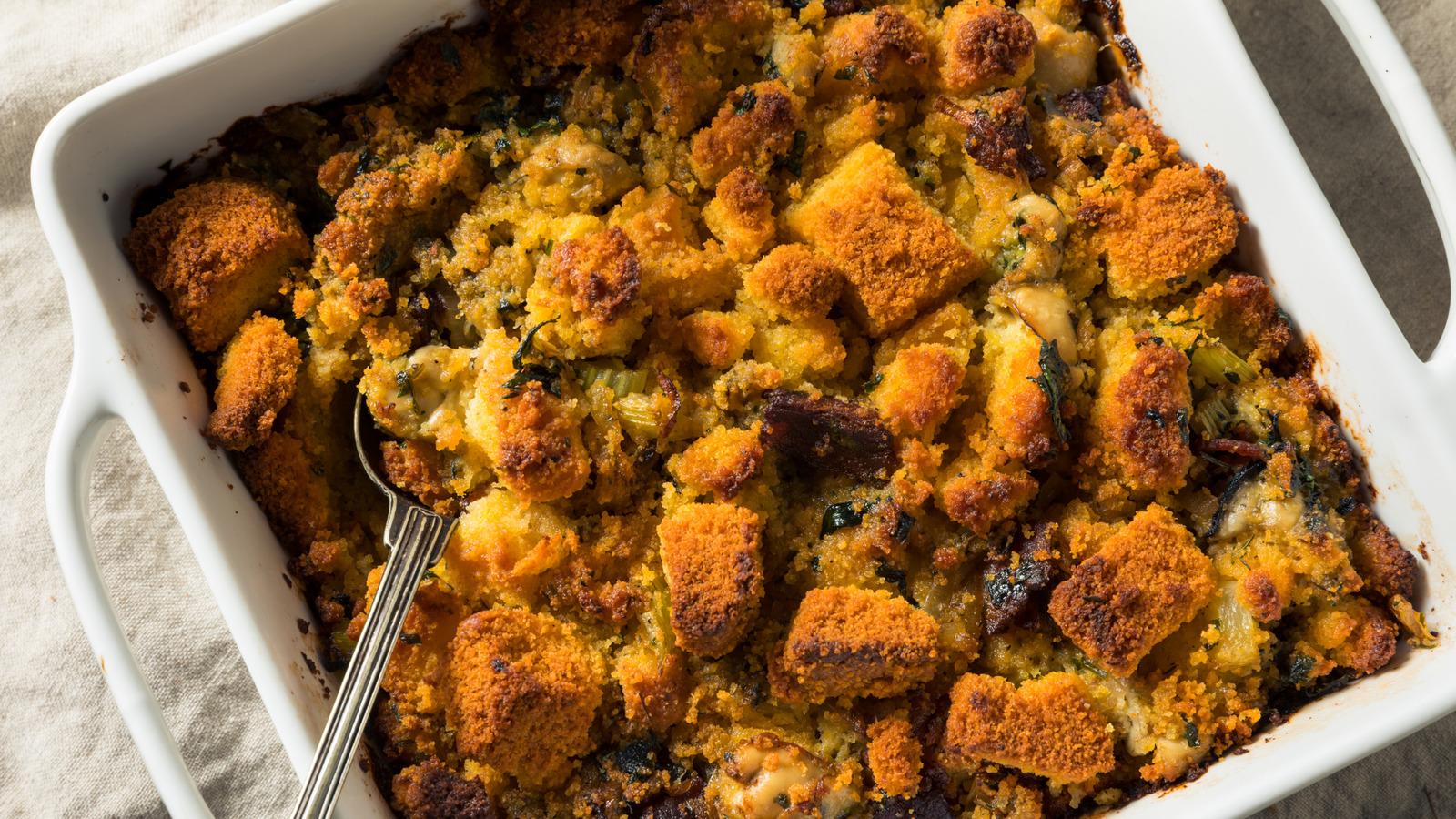
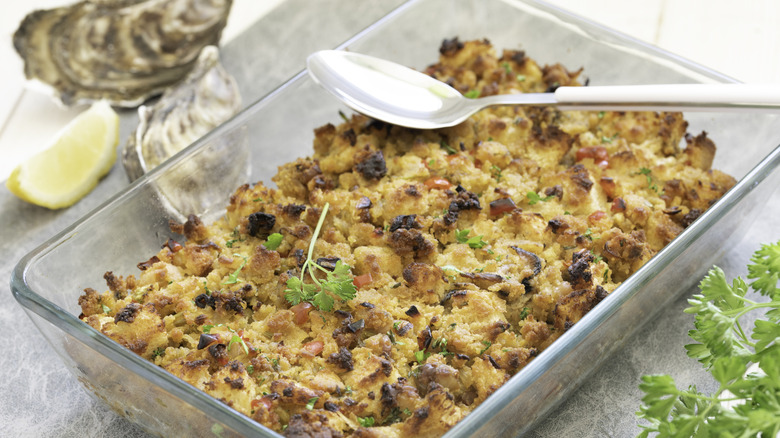
Enter: oyster dressing (or stuffing), a seafood-forward take on the classic side dish that has existed since the 17th century, if not earlier. The hearty creation includes many of the same ingredients as traditional stuffing, from celery and onions to chicken stock and crusty bits of bread. But rather than pieces of turkey, this version spotlights succulent oysters, their briny taste and meaty mouthfeel enhancing the savory flavors and tender texture of the bake.
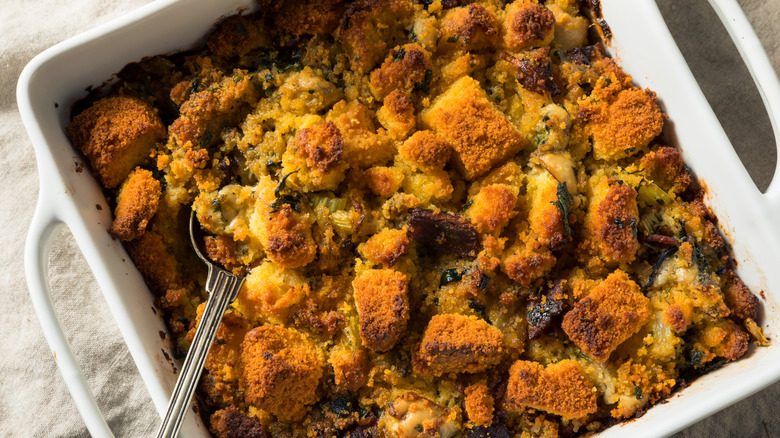
Although the overarching concept is the same — a starchy base, aromatic veggies, and juicy oysters coming together to make a moist, filling accompaniment to your main course — the exact specifications of one's oyster stuffing is going to vary from region to region. New Englanders may use breadcrumbs or day-old cubes of white bread, while cooks from the Carolinas prefer crumbled-up saltine crackers. And, hardly a surprise for those familiar with Southern cuisine, oyster dressing recipes hailing from below the Mason-Dixon line are usually going to call for a base of cornbread.
The history (and evolution) of oyster dressing
Gwenael Le Vot/Getty Images
You may be thinking to yourself, "Oysters with poultry? Who came up with that wild idea?" Well, an early iteration of this old school holiday casserole dates back to at least 1685, when an English cookbook first referred to stuffing a chicken's belly with oysters, herbs, and spices. British settlers brought the dish over to America, where it would also pop up in cookbooks in 1796 and 1830. Along the Northeastern coastline and Chesapeake Bay area, oysters were plentiful, and therefore cheap, so it makes sense that folks would utilize the tasty, easy-to-get protein.
Around the mid-19th century, refrigerated train cars allowed for the wider distribution of perishable food, including oysters. No longer relegated to the coastal regions where they were farmed, the briny bivalves made their way inland. Ironically, this turned the shellfish, which had long been considered a "working class food," into something of a status symbol given the price it cost to transport it. Oyster dressing, subsequently, earned a reputation as a fancy dish for special occasions.
One such occasion, of course, being Thanksgiving, which was experiencing a national surge as a source of unity in the aftermath of the Civil War. Who knew that one of the things to bring the North and South together would be the humble oyster and some stale bread? Fast forward to today and this oyster-filled side dish is still a staple on some Thanksgiving tables. If it's yet to appear on yours, it wouldn't be a bad idea to revive the tradition.

 English
 Arabic
 French
 Spanish
 Portuguese
 Deutsch
 Turkish
 Dutch
Dutch
 Italiano
 Russian
 Portuguese (Brazil)
 Greek
Greek