


This Worm Quietly Lived In A Lab For Decades, But They Had No Idea Just How Old It Truly Was
This Worm Quietly Lived In A Lab For Decades, But They Had No Idea Just How Old It Truly Was
A biologist with a passion for invertebrates had been caring for an unassuming worm in his lab for decades. Only recently did he decide to test out how old this unlikely pet really was – and he was pleasantly surprised by the results.
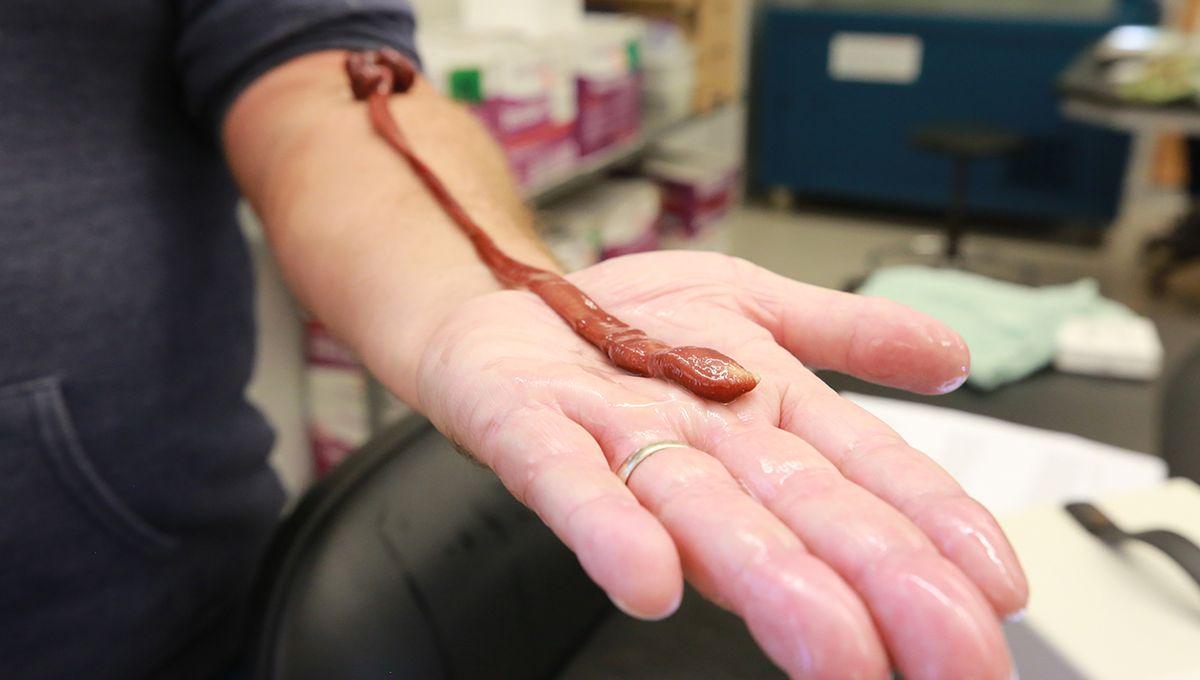
The rest of this article is behind a paywall. Please sign in or subscribe to access the full content. Jon Allen, an Associate Professor at William & Mary in Virginia, first came into contact with the veteran worm in 2005. While completing his doctorate in biology at the University of North Carolina at Chapel Hill, he learned that the building’s renovations would leave several invertebrate specimens without a place to live. Rather than see them homeless or chucked in the trash, Allen took them under his wing. One of the adoptees was a 90-centimeter (3-foot) ribbon worm, now known as “Baseodiscus the Eldest” or “B” for short, that was collected from a body of water in the late 1990s. It has followed Allen throughout his journeys since and currently lives in a tank at William & Mary, where he’s based at the moment. The worm lives a peaceful life in the lab, except each fall when Allen takes it out of its tank to dangle it in front of his students for show and tell. One day, former student Chloe Goodsell asked how old the worm was. Allen knew the animal was decades old, but curiosity prompted him to launch a more rigorous investigation. A tiny bit of tissue was sliced off the ribbon worm and sent to the Oregon Institute of Marine Biology for analysis. William & Mary students get an up-close look of the worm in class. Image courtesy of Stephen Salpukas The tests identified B as a species of ribbon worm (nemertean) called Baseodiscus punnetti. It also confirmed the individual worm is at least 23 years old, although likely closer to 30. This makes B the oldest ribbon worm ever recorded and proves that this genus can live exceptionally long lives. “Ribbon worms are an incredibly diverse and widespread phylum, yet almost nothing is known about their natural longevity,” Allen said in a statement. “This finding fills a genuine knowledge gap, increasing their known lifespan by an order of magnitude. This shifts our understanding of an entire major group of marine predators. Future research can leverage this knowledge to develop lifespan estimates for these creatures to better understand their ecological impact on marine ecosystems,” he added. Compared to their spiny cousins, many invertebrate animals are known to live incredibly long lives. Among the very oldest is a giant ocean quahog clam (Arctica islandica) found off the coast of Iceland in 2006. Born around the year 1499 CE, it was nicknamed "Ming" by the media as it started life during the time of the Ming dynasty in China. Unfortunately, this ancient clam met an untimely end in 2006 at the hands of some curious scientists. The study is published in the Journal of Experimental Zoology.

 English
 Arabic
 French
 Spanish
 Portuguese
 Deutsch
 Turkish
 Dutch
Dutch
 Russian
 Romaian
 Portuguese (Brazil)
 Greek
Greek