


7 Invasive Plants You Should Remove This Winter to Stop Their Spread in Spring
Weed out these invasive plants in wintertime when they're easier to see and reach.
Published on December 8, 2025
Courtesy of Getty Images
After the leaves have fallen and the trees are bare, it is much easier to see and remove certain invasive plants. Some woody plants and vines are simply too large, too dense, or too unruly to tackle during the growing season. Left unchecked, these invasives choke out native plants, girdle trees, and cause a host of other problems.
In this guide, you’ll find 7 common invasive plants that are easier to remove during the winter months, plus tips on how to get rid of them with organic methods.
Controlling invasive species organically takes time, effort, and persistence. If the infestation is large and heavy, you might not be able to get it under control without the targeted use of broad-spectrum herbicides such as glyphosate or triclopyr.
Oriental Bittersweet
igaguri_1 / Getty Images
Oriental bittersweet (Celastrus orbiculatus) is an invasive vine that girdles or pulls down fully grown trees. It's easy to identify by its bright orange berries, which are eaten and dispersed by birds. When it's large, this vine is more difficult to manage during the warmer months than in the winter when the woody vines are exposed. Cut the vines with pruners or a handsaw. If the vines are growing up a tree, don't pull them off, because this could bring down heavy branches and damage the tree.
To stay on top of bittersweet patches, repeated cutting will be necessary for at least a couple of years, both during the growing season and in the winter.
Unlike oriental bittersweet, American bittersweet (Celastrus scandens) is a North American native plant that doesn’t grow as aggressively and benefits wildlife. The fruit and flowers of American bittersweet grow at the tips of the vine, whereas Oriental bittersweet fruit and flowers grow along the stem. Before removing vines, make sure that you properly identify which type of bittersweet is growing on your property, as American bittersweet is an endangered plant in some states.
English Ivy
Winter is an ideal time to remove English ivy (Hedera helix) because it stays green when most other plants are leafless, so it's easy to spot. This vigorous vine damages masonry and causes tree branches to break under its weight.
To control it organically, cut the vines off at the soil line. Afterwards, clear the ground around the base of trees where ivy was growing to ensure you didn't miss any vines. If the ground isn't frozen, dig up any ivy roots you can find. Repeat this every winter until the plants are weakened and stop regrowing.
Japanese Barberry
Laurie Black
Japanese barberry (Berberis thunbergii) can be removed in any season, but it’s often easier to spot barberry stems in winter when snow covers the ground and makes the bright red barberries pop. Removing these plants in winter is also wise, because they tend to harbor high tick populations, which makes it riskier tackling them in summer.
Remove barberry plants by digging, hand-pulling, or using a weed wrench. Always wear thick leather gloves to protect against this plant's sharp thorns.
Without herbicides, barberry readily resprouts, so repeated removal during the growing season and in the winter is necessary to eradicate it.
Japanese Honeysuckle
Alexander Denisenko / Getty Images
Unlike desirable honeysuckle species that are native to North America, the Japanese honeysuckle (Lonicera japonica) is an invasive plant that spells trouble for gardens and ecosystems alike. This vining plant can be removed throughout the year, but tackling it in winter helps limit its spread and makes it a little easier to access the plant’s vines. To prevent it from coming back, cover the stumps with heavy tarps and leave them in place for at least the following growing season.
Porcelain Berry
Courtesy of Getty Images
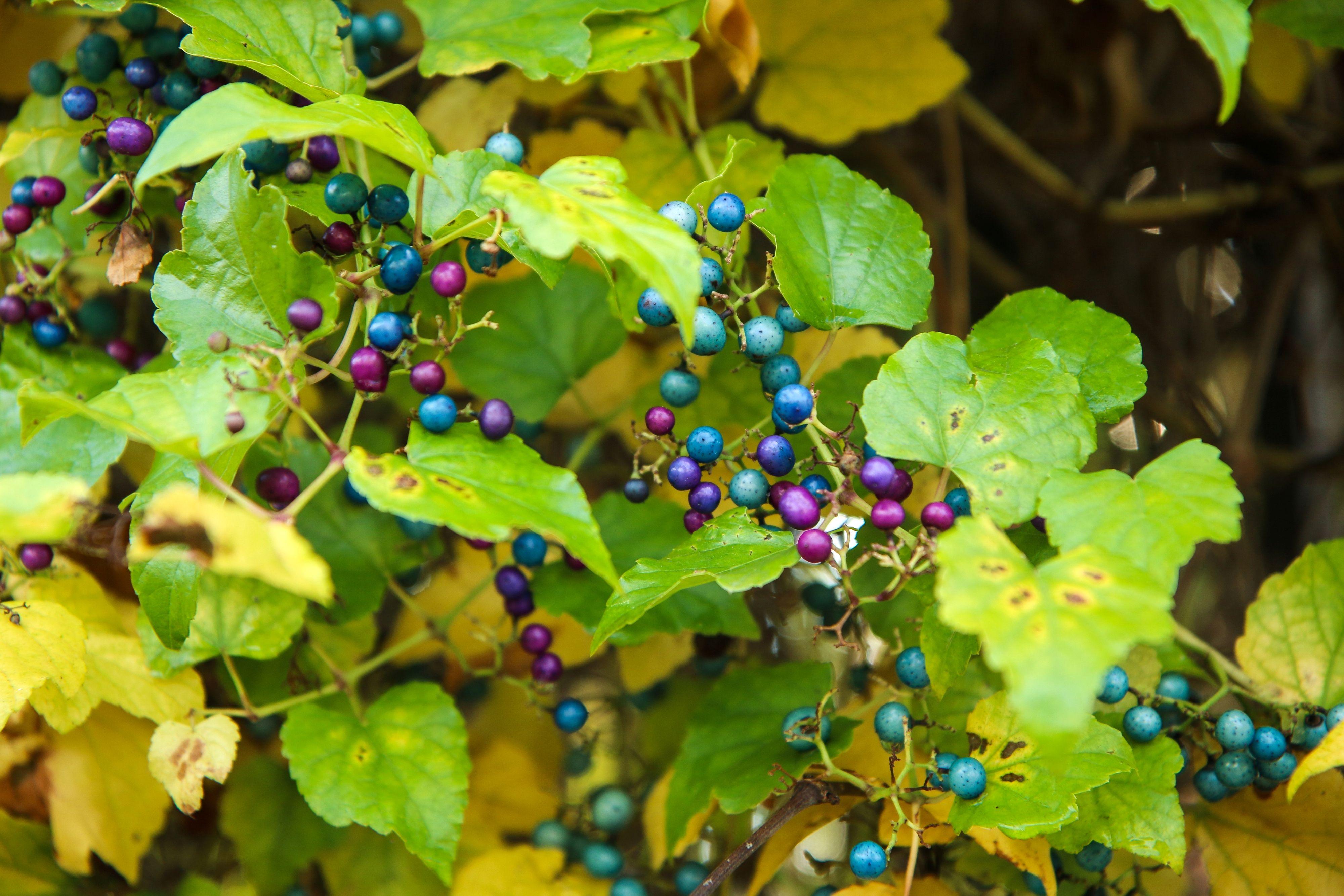
Porcelain berry (Ampelopsis brevipedunculata) has pretty, bright blue and purple berries. However, it's another aggressive woody vine that smothers other plants. It also resprouts from even the smallest sections of roots left behind after removal.
After cutting the vines at ground level in the winter, you will need to cover the area with a tarp for at least one growing season to prevent the roots and fallen berries from resprouting. As with other vining invasives, don’t bother pulling the vines off trees after cutting them; they will naturally shrivel up and decompose once the roots are severed.
Multiflora Rose
Jakob Berg / Getty Images
North America has several native roses, but the multiflora rose (Rosa multiflora) isn’t one of them. This aggressive grower creates thorny thickets that are difficult to remove during the growing season, when its dense leaves make its thorny stems hard to see. In winter, it’s much easier to access multiflora rose stems and they'll often have red hips, making it easier to spot the stems.
Cut them at the base with pruners or loppers, and always wear long leather gloves to protect your hands and arms. Repeatedly cutting any resprouts during the following growing season and beyond is necessary to eventually exhaust the plant and cause it to die out completely.
Common Buckthorn
Denny Schrock
Common buckthorn (Rhamnus cathartica) is a small tree or shrub that outcompetes native plants and even changes the soil composition so other plants have a harder time growing. It spreads easily by its dark berries. In winter, hand-pull small seedlings or cut larger plants down to the ground, then cover the stumps with tarps for at least one growing season to prevent them from resprouting.
Make sure to properly dispose of invasive plants that you removed. Some waste management companies won’t accept invasive plant material, and composting invasives potentially allows their seeds to spread unless they are exposed to temperatures of 145°F and above for at least one month.

 Arabic
 French
 Spanish
 Portuguese
 Deutsch
 Turkish
 Dutch
Dutch
 Italiano
 Russian
 Romaian
 Portuguese (Brazil)
 Greek
Greek