


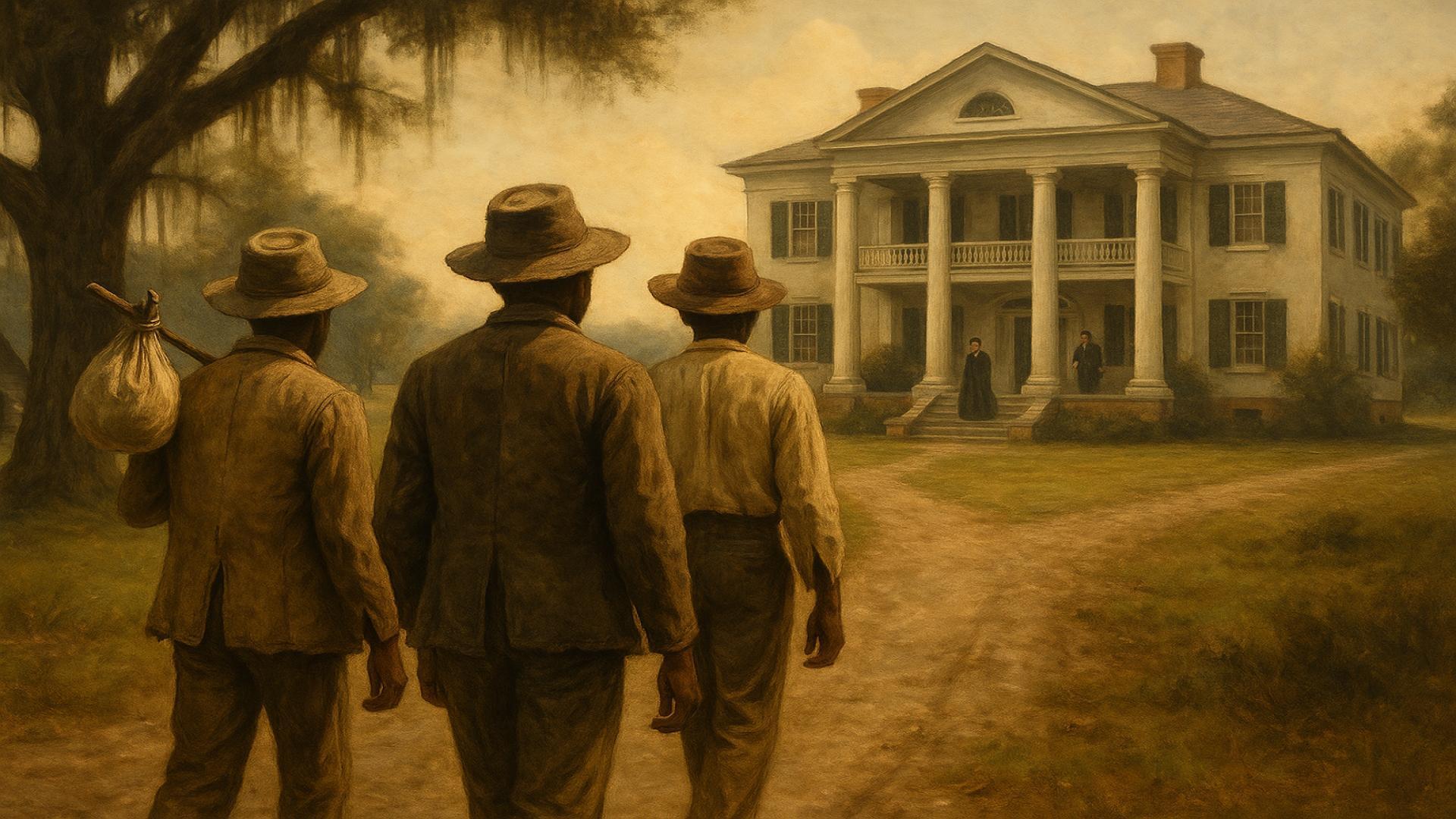
10 Major Slaveowner Families and How They Lost (or Kept) Power After the Civil War

0
3

10 Major Slaveowner Families and How They Lost (or Kept) Power After the Civil War - History Collection

4. The Randolph Family (Virginia)

10 Major Slaveowner Families and How They Lost (or Kept) Power After the Civil War
Randolph family endures postwar debt, selling Monticello yet forging new legacies in public service.

The Randolph family, descendants of Thomas Jefferson, faced significant financial challenges following the Civil War. Burdened by debt, they were compelled to sell Monticello and numerous other holdings. Despite these hardships, some family members established legacies in politics and academia. For instance, Thomas Jefferson Randolph, Jefferson’s grandson, served as a Virginia state legislator and was instrumental in managing Jefferson’s estate after his death.

5. The Hammond Family (South Carolina)

10 Major Slaveowner Families and How They Lost (or Kept) Power After the Civil War
The Hammond family adapts to post-Civil War upheaval by pursuing new business and political roles.

The Hammond family, led by James Henry Hammond, a prominent South Carolina politician and plantation owner, faced significant challenges after the Civil War. The abolition of slavery dismantled their labor-intensive cotton empire, leading to financial hardships and the loss of numerous properties. In response, the remaining family members sought to adapt by redeploying their assets into business ventures and political roles. For instance, James Henry Hammond’s grandson, James H. Hammond II, became active in state politics, serving as a State Representative and later as a State Senator in South Carolina (genealogytrails.com).

6. The Pinckney Family (South Carolina)

10 Major Slaveowner Families and How They Lost (or Kept) Power After the Civil War
Pinckney family’s transition from rice plantation wealth to new careers after slavery’s abolition.

The Pinckney family, once influential in South Carolina’s rice cultivation, faced significant challenges after the abolition of slavery. Their extensive rice estates, which had relied heavily on enslaved labor, were no longer viable, leading to the loss of many properties. While some family members retained smaller holdings, the family’s national political stature diminished. Successive generations adapted by pursuing careers in finance, law, and local politics, striving to rebuild their prominence in a transformed society (encyclopedia.com).

7. The Washington Family (Virginia)

10 Major Slaveowner Families and How They Lost (or Kept) Power After the Civil War
Washington descendants endure postwar hardship as Mount Vernon’s preservation shifts to charitable stewardship.

As descendants of George Washington, the family faced significant challenges following the Civil War. Mount Vernon and other holdings barely survived wartime turmoil. Charitable foundations helped preserve estate history, but their antebellum wealth vanished. The Mount Vernon Ladies’ Association acquired the estate in 1860, ensuring its preservation. However, the Washington family’s financial standing declined, and they were compelled to sell properties, including Claymont Court, due to economic hardships (washingtonpost.com).

8. The Telfair Family (Georgia)

10 Major Slaveowner Families and How They Lost (or Kept) Power After the Civil War
Telfair Museums preserve the cultural legacy of a once-powerful Savannah family through art and history.

The Telfair family, major slaveholders in Savannah, Georgia, faced financial ruin after the Civil War. Their mansions were sold, and their wealth dissipated. However, their philanthropic legacy endures through the Telfair Museums, established in 1886. The museums, comprising the Telfair Academy, Owens-Thomas House & Slave Quarters, and Jepson Center for the Arts, house over 4,500 works of art, preserving the family’s cultural impact in Georgia (telfair.org).

9. The DeSaussure Family (South Carolina)

10 Major Slaveowner Families and How They Lost (or Kept) Power After the Civil War
DeSaussure family members adapt careers post-Civil War, shifting from plantation wealth to professional roles.

The DeSaussure family, once prominent in Charleston, South Carolina, experienced significant financial decline following the Civil War. Many plantation assets were lost, compelling descendants to seek new livelihoods. Some became lawyers, such as Wilmot Gibbes DeSaussure, who served in the South Carolina House of Representatives and as a Confederate officer. Others pursued careers in banking and education, adapting to the post-war economic landscape.

10. The Davis Family (Mississippi)

10 Major Slaveowner Families and How They Lost (or Kept) Power After the Civil War
Jefferson Davis’s Brierfield plantation after the Civil War, symbolizing loss, resilience, and legacy.

Jefferson Davis’s Brierfield plantation was severely impacted by the South’s defeat in the Civil War. Union troops ransacked the property in 1863, taking enslaved individuals and valuables. After imprisonment, Davis faced financial ruin but recast himself as a symbol of the Confederacy. Some family members pursued public service or writing; for instance, his daughter, Margaret Howell Davis, became a writer and philanthropist. Davis’s memoir, “The Rise and Fall of the Confederate Government,” published in 1881, reflects his post-war endeavors (mississippiencyclopedia.org).

Conclusion

10 Major Slaveowner Families and How They Lost (or Kept) Power After the Civil War
Resilient slaveholding families leveraged social networks to regain influence after Reconstruction-era economic upheaval…

The post-Civil War era presented profound challenges for major slaveholding families, as emancipation and Reconstruction dismantled their economic foundations. Many faced financial hardships, losing vast estates and wealth. However, some adapted by leveraging existing social networks and political connections, enabling them to rebuild fortunes and influence within a generation. This resilience underscores the complex interplay between economic upheaval and social capital in shaping the trajectories of these families during a transformative period in American history (aeaweb.org).

Αναζήτηση
Κατηγορίες
Διαβάζω περισσότερα
Technology
The key words from Apples Awe Dropping event are battery life
The key words from Apple's 'Awe Dropping' event are 'battery life'...
από Test Blogger7 2025-09-10 12:00:13 0 1χλμ.
Science
Brunhes-Matuyama Reversal: Listen The Earth's Magnetic Fields Flip 780,000 Years In The Past
Brunhes-Matuyama Reversal: Listen The Earth's Magnetic Fields Flip 780,000 Years In The...
από test Blogger3 2025-07-15 15:00:10 0 2χλμ.
Technology
Nab a pair of refurbished Samsung Galaxy Buds3 Pro for $125 off at Best Buy
Best earbud deal: Get a pair of refurbished Samsung Galaxy Buds3 Pro for $125 off...
από Test Blogger7 2025-06-19 17:00:19 0 2χλμ.
Technology
The best Prime Big Deal Days deals under $50 available now
Best October Prime Day deals under $50 The...
από Test Blogger7 2025-10-08 08:00:17 0 817
Παιχνίδια
New shooter feels like Escape From Tarkov with dinosaurs, and you can try it now
New shooter feels like Escape From Tarkov with dinosaurs, and you can try it now As an Amazon...
από Test Blogger6 2025-05-28 23:34:52 0 3χλμ.