


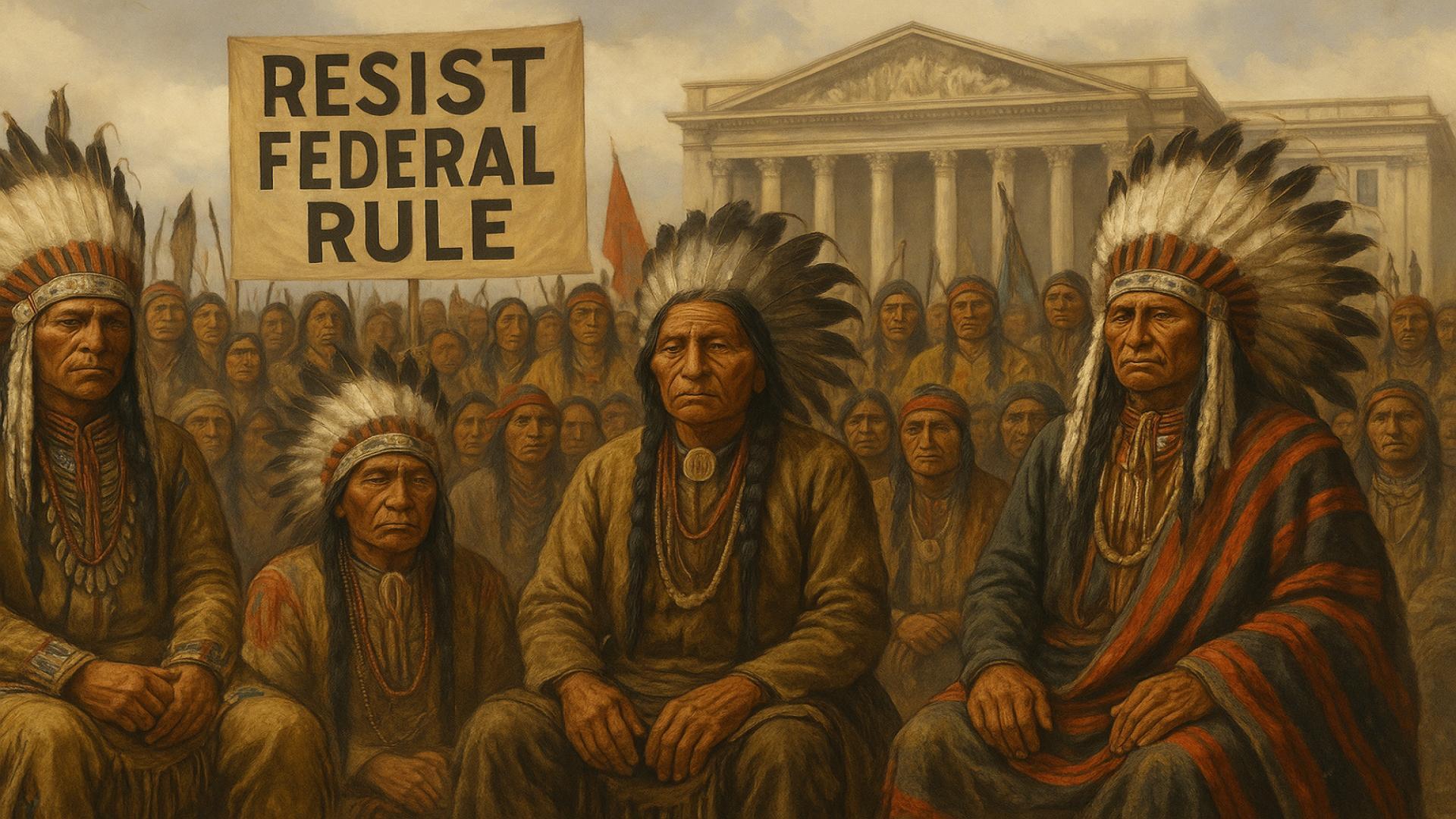
15 Legendary Native American Chiefs Who Resisted Federal Rule

0
22

15 Legendary Native American Chiefs Who Resisted Federal Rule - History Collection

3. Crazy Horse (Oglala Lakota Sioux)

15 Legendary Native American Chiefs Who Resisted Federal Rule
Crazy Horse leads Lakota warriors to victory at Little Bighorn, symbolizing Native resilience and sovereignty.

Crazy Horse, born around 1840 near present-day Rapid City, South Dakota, was a revered leader of the Oglala Lakota Sioux. He played a pivotal role in the Sioux Wars, demonstrating exceptional tactical skills and a deep commitment to protecting Lakota lands. Notably, he was instrumental in the Battle of Little Bighorn, where his forces, alongside those of Sitting Bull, decisively defeated General George Armstrong Custer’s 7th Cavalry. This victory became a symbol of Native sovereignty and resilience. After years of evading capture, Crazy Horse surrendered to U.S. troops under General George Crook in May 1877. Tragically, he was fatally bayoneted by a military guard while allegedly resisting imprisonment at Fort Robinson, Nebraska, on September 5, 1877 (britannica.com).

4. Chief Joseph (Nez Perce)

15 Legendary Native American Chiefs Who Resisted Federal Rule
Chief Joseph leads the Nez Perce on a courageous 1,700-mile retreat before surrendering in 1877.

Chief Joseph, born Hin-mah-too-yah-lat-kekt in 1840, led the Nez Perce tribe during their resistance against U.S. forces in 1877. Faced with forced relocation from their ancestral lands in Wallowa Valley, Joseph led his people on a 1,600-1,700-mile retreat across Oregon, Washington, Idaho, and Montana, skillfully evading and engaging U.S. troops. After a five-day battle in the Bear Paw Mountains, just 40 miles from the Canadian border, Joseph surrendered to General Nelson A. Miles on October 5, 1877. In his poignant surrender speech, he declared, “From where the sun now stands, I will fight no more forever,” expressing his exhaustion and desire for peace (britannica.com).

5. Red Cloud (Oglala Lakota Sioux)

15 Legendary Native American Chiefs Who Resisted Federal Rule
Red Cloud, Oglala Lakota leader, secured historic territorial rights through strategic resistance and diplomacy.

Red Cloud, born in 1822 near the Platte River in Nebraska, was a prominent leader of the Oglala Lakota Sioux. He led successful campaigns against U.S. forts along the Bozeman Trail, compelling the government to sign the Treaty of Fort Laramie in 1868 (pbs.org). This treaty recognized Lakota territorial rights, including the Black Hills, and marked a rare instance where Native American resistance led to a favorable agreement. Red Cloud’s unique blend of military prowess and diplomatic skill secured temporary peace for his people.

6. Tecumseh (Shawnee)

15 Legendary Native American Chiefs Who Resisted Federal Rule
Tecumseh, Shawnee chief and military leader, united tribes to resist U.S. expansion and defend Native lands.

Tecumseh, born in 1768 near present-day Xenia, Ohio, was a Shawnee chief, orator, and military leader who advocated for a pan-tribal confederacy to resist U.S. expansion. He traveled extensively, uniting tribes from the Great Lakes to the South, and opposed the sale of Native lands to settlers. During the War of 1812, Tecumseh allied with the British, capturing Detroit and invading Ohio. He was killed in the Battle of the Thames on October 5, 1813 (britannica.com).

7. Black Hawk (Sauk)

15 Legendary Native American Chiefs Who Resisted Federal Rule
Black Hawk, Sauk leader, defied U.S. treaties and inspired resistance during the 1832 Black Hawk War.

Black Hawk, born Ma-ka-tai-me-she-kia-kiak in 1767 near present-day Rock Island, Illinois, was a prominent leader of the Sauk tribe. In 1832, he led his people back to their ancestral lands in Illinois, defying a treaty that ceded these territories to the United States (rivermuseum.org). This act of resistance led to the Black Hawk War, a brief but intense conflict that ended with his capture. Despite his defeat, Black Hawk’s leadership and determination left a lasting impression on U.S. society, highlighting the Native struggle for homeland and sovereignty.

8. Osceola (Seminole)

15 Legendary Native American Chiefs Who Resisted Federal Rule
Osceola leads Seminole warriors in a daring ambush, exemplifying resistance during the Second Seminole War.

Osceola, born Billy Powell around 1804 in the Mississippi Territory, emerged as a formidable leader during the Second Seminole War (1835-1842). A member of the Creek tribe who migrated to Florida, he became a symbol of resistance against the U.S. government’s attempts to forcibly relocate the Seminole people. In 1835, Osceola led a successful ambush against U.S. troops, marking a significant escalation in the conflict. His strategic acumen enabled his small band to outmaneuver much larger U.S. forces, leaving a legacy of Seminole defiance. In October 1837, under a flag of truce, Osceola was captured by U.S. forces and imprisoned at Fort Moultrie in South Carolina, where he died on January 30, 1838 (nps.gov).

9. Chief Seattle (Duwamish and Suquamish)

15 Legendary Native American Chiefs Who Resisted Federal Rule
Chief Seattle, influential Duwamish and Suquamish leader, advocated peace and environmental stewardship in the 1850s.

Chief Seattle, born around 1790, was a prominent leader of the Duwamish and Suquamish tribes in the Pacific Northwest. In 1854, he met with Governor Isaac Stevens to discuss the sale of tribal lands. While the exact words of his speech are uncertain, it is known that he advocated for peaceful coexistence and expressed concerns about the impact of settlers on the land. His name was later adopted for the city of Seattle, and his legacy continues to inspire environmental movements (suquamish.nsn.us).

10. Pontiac (Odawa)

15 Legendary Native American Chiefs Who Resisted Federal Rule
Pontiac, Odawa chief, unites tribes in 1763 uprising, reshaping colonial policy and Indigenous resistance.

Pontiac, born around 1720 near the Maumee River (now in Ohio), was an influential Odawa chief who led a significant resistance against British colonial rule in the Great Lakes region. In 1763, he orchestrated a coordinated attack known as Pontiac’s War, targeting British forts and settlements to expel them from Native lands (battlefields.org). His leadership and strategic acumen galvanized various tribes, reshaping colonial policies and highlighting Indigenous agency in early America.

11. Mangas Coloradas (Chiricahua Apache)

15 Legendary Native American Chiefs Who Resisted Federal Rule
Mangas Coloradas, influential Chiricahua Apache chief, united tribes against encroachment in the Southwest.

Mangas Coloradas, born around 1793, was a prominent leader of the Chiricahua Apache tribe. He became chief of the Mimbreño Apache in 1837, uniting various Apache bands against Mexican and later American encroachment in the Southwest. His alliances with other Apache leaders, including his son-in-law Cochise, intensified resistance efforts. (native-languages.org). Mangas Coloradas’ leadership and strategic acumen left a lasting legacy in the Apache struggle for sovereignty.

12. Quanah Parker (Comanche)

15 Legendary Native American Chiefs Who Resisted Federal Rule
Quanah Parker, last Quahadi Comanche chief, led resistance and guided his people through transition.

Quanah Parker, born around 1845 near Wichita Falls, Texas, was the last chief of the Quahadi band of the Comanche Nation. He was the son of Peta Nocona, a Comanche chief, and Cynthia Ann Parker, a white woman captured by the Comanche in 1836. Quanah became a prominent leader, known for his resistance against U.S. expansion and his efforts to adapt his people to reservation life. In 1874, he led the Quahadi in the Battle of Adobe Walls, a significant conflict during the Red River War. After the war, Quanah guided his people to the reservation at Fort Sill, Oklahoma, where he became a successful rancher and advocate for Comanche rights. He also played a key role in the Native American Church, promoting the use of peyote in religious ceremonies. Quanah Parker died on February 23, 1911, and is buried at Fort Sill Post Cemetery (britannica.com).

13. Chief Moses (Sinkiuse-Columbia)

15 Legendary Native American Chiefs Who Resisted Federal Rule
Chief Moses, Sinkiuse-Columbia leader, advocated for his people amid land disputes and relocation.

Chief Moses, born Kwiltalahun around 1829, was a prominent leader of the Sinkiuse-Columbia tribe in present-day Washington State (historylink.org). Educated at a Presbyterian mission, he became fluent in multiple languages, including English and Nez Perce. As chief, he navigated increasing conflicts with white settlers, striving to protect his people’s lands. Despite his efforts, the tribe faced forced relocation to the Colville Reservation, where Chief Moses died in 1899.

14. Little Turtle (Miami)

15 Legendary Native American Chiefs Who Resisted Federal Rule
Little Turtle, Miami chief and strategist, led Native victories and later diplomacy in the Northwest Indian War.

Little Turtle, born around 1752 near Fort Wayne, Indiana, was a prominent chief of the Miami people. He led a formidable Native alliance that delivered major defeats to U.S. forces in the Northwest Indian War, notably at the Battle of Harmar’s Defeat in 1790 and the Battle of St. Clair’s Defeat in 1791 (battlefields.org). His subsequent diplomatic efforts, including signing the Treaty of Greenville in 1795, spotlighted the delicate balance between resistance and negotiation.

15. Chief Pushmataha (Choctaw)

15 Legendary Native American Chiefs Who Resisted Federal Rule
Chief Pushmataha: Choctaw leader, War of 1812 ally, and staunch defender of tribal rights.

Chief Pushmataha, born around 1764 near present-day Macon, Mississippi, was a distinguished leader of the Choctaw Nation. Renowned for his military prowess, he played a pivotal role in the War of 1812, notably in the Battle of New Orleans. Despite his alliance with the United States, Pushmataha was a steadfast advocate for Choctaw rights and resisted forced removal from ancestral lands. His leadership is commemorated in Mississippi through monuments and the naming of towns in his honor (encyclopediaofalabama.org).

Conclusion

15 Legendary Native American Chiefs Who Resisted Federal Rule
Fifteen influential Native American chiefs whose leadership and strategies shaped enduring Indigenous resistance and sov…

The fifteen chiefs highlighted in this article exemplify the resilience and determination of Native American leaders who resisted federal encroachment on their lands and cultures. Their diverse strategies—ranging from military engagement to diplomatic negotiation—have profoundly influenced the history and identity of Indigenous resistance. Today, their legacies continue to inspire ongoing discussions about Indigenous rights, sovereignty, and cultural heritage, underscoring the enduring relevance of their struggles in contemporary movements for justice and self-determination.

Search
Categories
Read More
Music
Second Warped Tour Festival Date Officially Announced for 2026
Second Warped Tour Festival Date Officially Announced for 2026We now have a second Vans Warped...
By Test Blogger4 2025-07-30 15:00:08 0 1K
Games
Fallout 76 Burning Springs is pulling me back into the multiplayer RPG, but it isn't just the new region that's on fire
Fallout 76 Burning Springs is pulling me back into the multiplayer RPG, but it isn't just the new...
By Test Blogger6 2025-12-03 12:01:28 0 151
Music
The Vinyl Record That's Illegal to Buy in 8 U.S. States (And Why)
The Vinyl Record That's Illegal to Buy in 8 U.S. States (And Why)Rock, punk and...
By Test Blogger4 2025-06-25 19:00:09 0 2K
History
Melamine Market Future Scope: Growth, Share, Value, Size, and Analysis
"What’s Fueling Executive Summary Melamine Market Size and Share Growth The...
By Aryan Mhatre 2025-11-11 07:11:43 0 1K
Games
Valve may be about to drop its Steam Frame VR headset during Meta Connect
Valve may be about to drop its Steam Frame VR headset during Meta Connect The Steam Frame...
By Test Blogger6 2025-09-17 17:00:16 0 1K