


The Moon Will Travel Across The Sky With A Friend On Sunday. Here's What To Know
The Moon Will Travel Across The Sky With A Friend On Sunday. Here's What To Know
We hope you enjoyed the Supermoon last night. The last full Moon of the year was quite splendid from our location, and it's just one of the lovely things that will be visible in the sky this month. The next big thing is happening just this weekend.
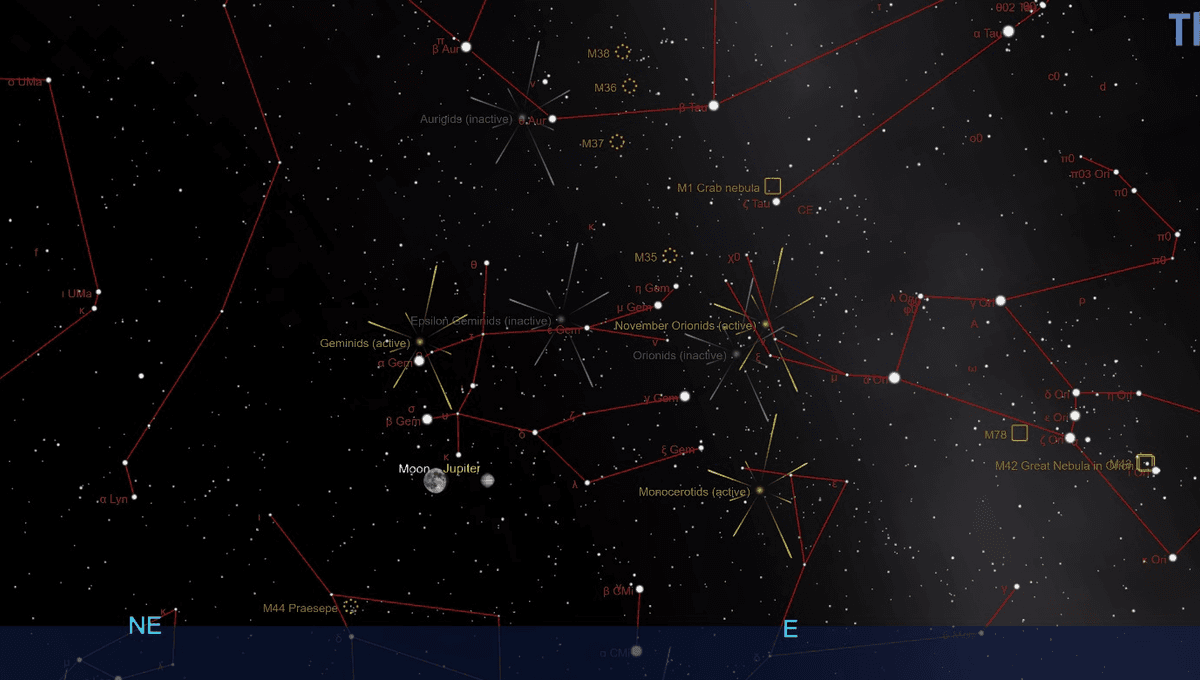
The rest of this article is behind a paywall. Please sign in or subscribe to access the full content. Not all of you will be early risers, so we'll start with an event that will be visible all night. In the evening of Sunday, December 7, right from the moment the Moon rises until the following morning, our natural satellite will be accompanied across the sky by the planet Jupiter, which is quite bright at the moment. This apparent proximity in the sky is known as a conjunction. Two celestial bodies appear near each other from our point of view, even though in reality they are many hundreds of millions of kilometers apart. You do not need any special equipment for it, and even in the center of cities, this spectacle will be visible. “Both Jupiter and the Moon will appear bright in the sky, making this an ideal target for observing with the naked eye, binoculars, and small telescopes," the Royal Observatory Greenwich team of astronomers wrote about the event. "Using a small telescope, you may be able to see four Galilean moons, as well as a detailed views of mountains and valleys along our Moon’s terminator (the line where the illuminated area meets the shadowed area).” You will not miss Jupiter. The planet is so much brighter than any star, and there is a neat trick to distinguish between planets and stars: Planets don't twinkle! Despite appearing point-like, just like stars do, they are little disks, so the tremors of the atmosphere cancel them out. If you are into planets and also like to get up pre-dawn (much easier in the Northern hemisphere now that it is winter here), also on Sunday, you can catch Mercury at its westernmost elongation, the moment it's farthest from the Sun. Just look for it before the Sun rises, and without a telescope (you don't want to catch the Sun with a telescope). ⓘ IFLScience is not responsible for content shared from external sites. December has plenty more to give for skywatchers, with a lot of other interesting stuff happening. Next weekend will be the peak of the Geminids, a very prolific meteor shower, as Earth passes through the trail of debris of the strange blue asteroid 3200 Phaethon. Though the gibbous Moon might make things a bit bright, the peak on the weekend of Dec 13-14 might offer up to 40-50 meteors an hour, according to NASA. And on December 19, the cometary diva of the year, interstellar comet 3I/ATLAS, will be at its closest approach to Earth. It is actually almost twice the Earth-Sun distance away, so you will need a telescope to spot it, but who knows when we’ll have a chance to see an object from another Solar System pass near to Earth again?

 English
 Arabic
 French
 Spanish
 Portuguese
 Deutsch
 Turkish
 Dutch
Dutch
 Italiano
 Romaian
 Portuguese (Brazil)
 Greek
Greek