


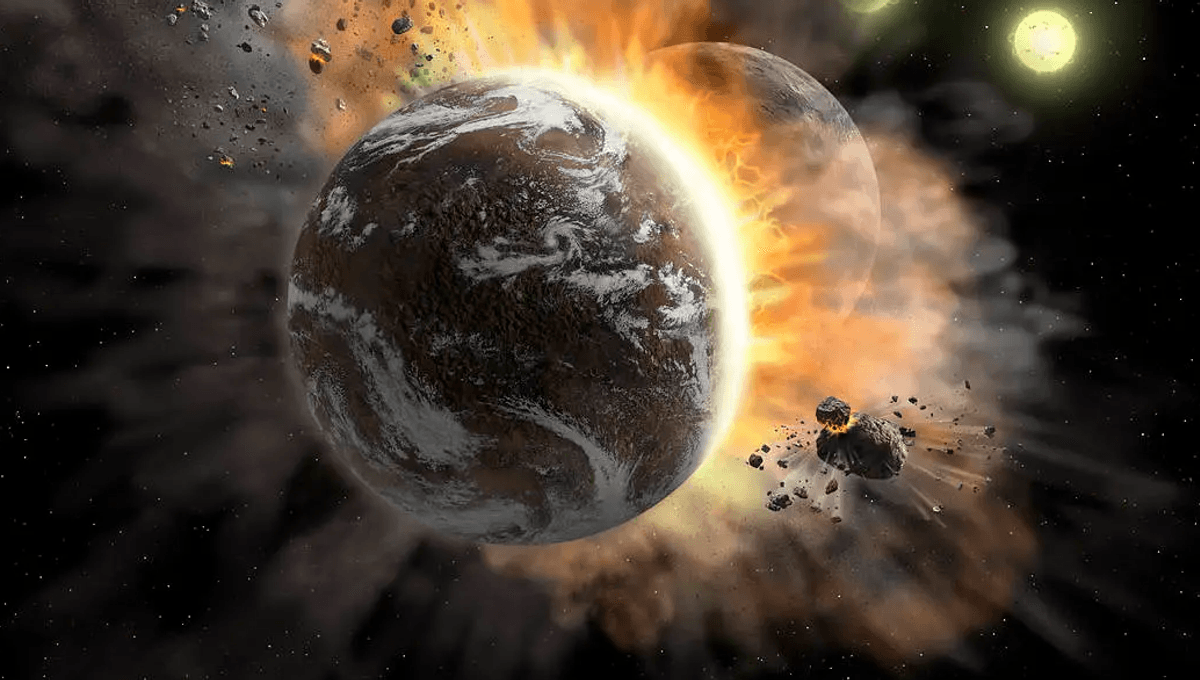


In about 5 billion years, the Sun will run out of hydrogen at its core. This will make it swell up into a red giant, as it begins to fuse helium instead. In the process, we can say goodbye to Mercury for sure, Venus most likely, and probably even Earth. But this assumes that nothing affects the Solar System in the meantime, and that is not a certainty. As we travel around the galaxy, we might encounter stars, and even from a distance, they can cause havoc with the planetary order.
A new paper argues that previous attempts at envisioning the effects of interactions between our planetary system and other stars severely overestimate the stability of the planets. Recent work had already suggested that a small variation in the orbit of Neptune could cause Mercury to be flung out away from the Sun, either into a collision with one of the planets or far into interstellar space. The new work shows a simulation where the situation is more dire. The scenarios project our Solar System passing by near stars over the next several billion years. The team estimates about 19 passages per million years within 1 parsec from the Sun, which is about 3.26 light-years; that is a bit closer than the closest star to us right now, which is at 4.25 light-years. In their simulation over the course of the next 5 billion years, 2 percent of scenarios end up with lost planets. And what happens in those scenarios? Well, Pluto has a 5 percent chance of becoming unstable, as a consequence of the perturbation to the giant planet’s orbit. Mercury is once again first in line to leave the Solar System, orbiting so close to the Sun makes it is the statistically closest planet to any other world in the Solar System. Not a good thing since the probability of instability increased by 50 to 80 percent. Earth has a 1-in-500 (0.2 percent) chance that it will be lost due to either being ejected from the Solar System or colliding with another world. Do not think that being on Mars could be a way for humanity to survive either; the Red Planet has a slightly bigger chance (0.3 percent) of colliding with another world or being lost to the dark of interstellar space. The simulation actually suggests that a planetary loss scenario happens sooner rather than later, making stellar field passage the main cause of instability in the Solar System for the next 4 to 4.5 billion years. Luckily, we are not getting any stars close to us for a long while. Let’s hope we have a solution for when we do. The study is published in the journal Icarus.


 English
 Arabic
 French
 Spanish
 Portuguese
 Deutsch
 Dutch
Dutch
 Italiano
 Russian
 Romaian
 Portuguese (Brazil)
 Greek
Greek